
Republican Lies Fall Apart as Ohio Hospital Denies Talarico Story
AUSTIN — James Talarico has never said "oh, I love this one too" about his own old tweets. He has never operated on a child. He has never sung "My Favorite Things" in a dirndl about transgender kids. And according to the Ohio psychiatric hospital at the center of this weekend's viral scandal, he has never been a patient there.
Millions of Texans have now seen or heard versions of all of it anyway.
Three weeks before the Nov. 3 election, Talarico, the Democratic US Senate nominee, has become the country's most deepfaked candidate. The fakes have come from the Republican Party's Senate campaign arm, from his opponent, Attorney General Ken Paxton, and from outside groups. Over the weekend, the attacks moved past synthetic video. A disputed recording of a phone call, amplified by the owner of X, was used to claim Talarico had secretly been in a mental hospital.
The first fake: "a Pandora's box"
It began March 11. The National Republican Senatorial Committee posted an 85-second video of an AI-generated Talarico reading his real 2021 tweets on transgender issues, race and religion, plus a 2013 tweet about attending a Planned Parenthood event, CNN's Daniel Dale reported. The fake also added gushing lines Talarico never said, such as "oh, this one is so touching."
"The face and voice are very good," Hany Farid, a UC Berkeley digital-forensics professor, told CNN. "This is hyper-realistic and I don't think that most people would immediately know it is fake." The only disclosure was a small, faint "AI GENERATED" label in the corner. Farid said that label didn't come close to appropriate disclosure for people scrolling quickly through X or YouTube, and he warned campaigns against opening a Pandora's box.
NRSC communications director Joanna Rodriguez said Democrats were "panicking after hearing James Talarico's own words." Talarico spokesperson JT Ennis replied: "While they spend their time making deepfake AI videos to mislead Texans, we are uniting the people of Texas to win in November." Sen. Andy Kim, D-N.J., called for national action: "These deepfakes are dangerous and wrong."
The escalation
The fakes kept coming.
June: Citizens for Sanity, a pro-Trump group, ran a 15-second clip of an AI-generated Talarico, first reported by the Daily Caller as a six-figure buy. (An analysis of Meta's ad archive suggests its Facebook and Instagram spending was far smaller.) In the clip, an AI Talarico in a dress sings a "Sound of Music" parody about transgender kids. HuffPost reported the ad does not appear to say it is AI-generated.
Aug. 7: American Principles Project PAC released a 30-second spot remaking Lyndon Johnson's 1964 "Daisy" ad. Instead of a nuclear blast, an AI "Dr. Talarico" pulls down a surgical mask over a little girl on an operating table. APP billed it as the launch of a $10 million midterm campaign. "This AI deep fake ad is flat out lying," the Talarico campaign said. "James does not support gender reassignment surgery for minors."
Sept. 8: Paxton's own campaign released a 30-second ad in which an AI Talarico reads from a "King James Talarico Bible." FactCheck.org found the ad stripped some remarks of context, strung separate comments together, and added phrases Talarico never said.
Talarico told CBS News that Paxton is "lying to the people of Texas" and putting "words in my mouth." He also said his own campaign would not use AI.
President Donald Trump has pushed the same themes without AI. He has repeatedly claimed Talarico believes in "six genders." That twists a 2021 committee exchange in which Talarico said there were six biological sexes, citing chromosome variations, not genders. Talarico has since said there are not six sexes and that some past remarks missed the mark.
The mental-hospital story
Talarico was sick and off the campaign trail from late September until Oct. 9. That gap became the opening for the weekend's attack.
GOP strategist Caroline Wren told Steve Bannon she was "hearing that he checked himself into a mental institution." Commentator Spencer Pratt posted, "My sources are telling me Talarico is in a mental health facility." Trump joked at a rally that Talarico "had the longest flu ever recorded."
Then on Oct. 11, right-wing influencer Nick Sortor posted on X: "BREAKING EXCLUSIVE: Ohio mental hospital CONFIRMS James Talarico was discharged from the facility earlier this week." He added that "the 'flu' thing" was a big lie. His evidence was part of a phone call that influencer Rhein Amacher had made to the Lindner Center of Hope in Mason, Ohio. In it, a woman says Talarico "was discharged this evening."
Elon Musk replied to a post sharing the clip: "The Talarico campaign is hiding something big that voters ought to know about." Musk is not a private bystander. On Sept. 30, War Secretary Pete Hegseth named him co-lead of Project Meridian, a Pentagon study on the future of warfare, returning him to an official role in the Trump administration. White House aide Stephen Miller demanded Talarico's medical records.
The story fell apart within hours:
The hospital denied it. That night the Lindner Center posted: "Representative James Talarico has never received treatment from Lindner Center of Hope." No hospital "confirmed" anything.
The timeline didn't work. Amacher said he made the call Oct. 10. But Talarico had appeared in public at Austin City Limits on Oct. 9 and with Kacey Musgraves on Oct. 10.
The recording didn't match the post. Current Revolt, a Texas outlet, published the full 6-minute, 40-second recording. It reported that the "earlier this week" claim in Sortor's post appears nowhere on it, and that Amacher had given a fake patient code.
Ennis called the story "a lie designed to promote a pathetic conspiracy theory."
Was the voice on the call synthetic? Journalist Laura Bassett posted that Musk suspended an account that had shown the recording was AI-generated, and that Community Notes were being blocked. No mainstream outlet has confirmed the suspension, no forensic finding has been published, and X has not commented. Community Notes were in fact later attached to Sortor's post, one calling the timeline impossible.
Talarico answered with one line on X, quoting the hospital's denial: "I've never even been to Ohio 😂"
By then the claim had already raced across some of the biggest accounts on the right. Sortor's "BREAKING EXCLUSIVE" was quoted and reposted again and again. Libs of TikTok called Talarico "UNFIT TO SERVE." DC_Draino told followers Talarico had been "caught" leaving a mental hospital in Ohio. Eric Daugherty claimed Talarico "snuck to a mental hospital" and that "Donald Trump knew something." All of it traced back to the one disputed phone call.
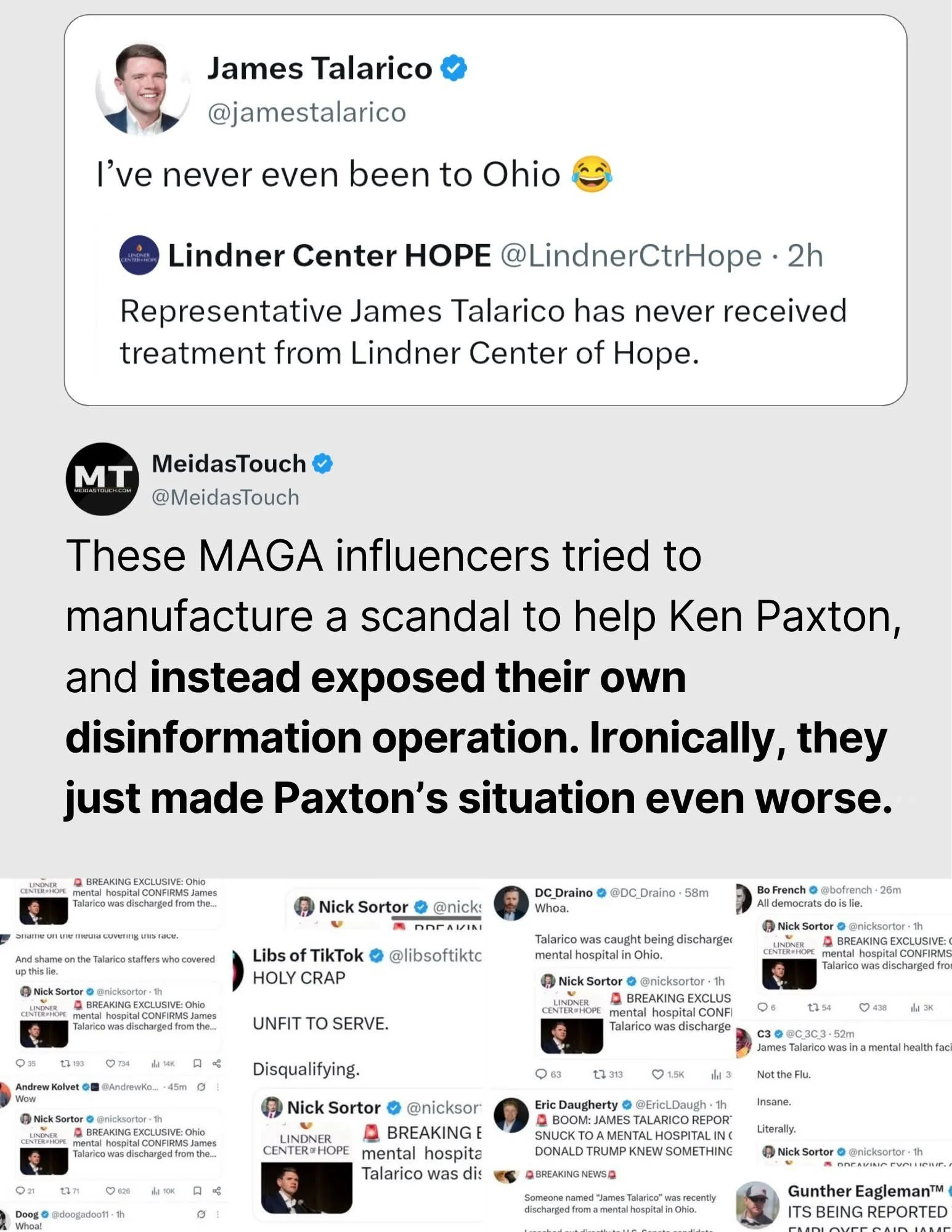
Top: Talarico’s reply to the Lindner Center of Hope’s denial. Middle: MeidasTouch’s take. Bottom: a sampling of the posts that spread the false claim before it collapsed. Screenshots from X.
Who's minding the store?
The answer, mostly, is no one.
Texas: A 2019 Texas law (SB 751, Election Code §255.004) makes it a Class A misdemeanor to publish a deceptive deepfake video meant to injure a candidate, but only within 30 days of an election. The Houston Chronicle reports the law doesn't apply to federal races, so it may not reach a US Senate race at all. Most of the anti-Talarico fakes also appeared outside that window.
Federal Election Commission: On Sept. 19, 2024, the FEC voted 5-1 against writing the AI rules Public Citizen had petitioned for. It issued only an interpretive rule saying its ban on fraudulent misrepresentation applies no matter what technology is used.
Federal Communications Commission: In 2024 the FCC proposed requiring AI disclosures in TV and radio political ads. The proposal was never adopted. Brendan Carr, who dissented and called it unlawful, now chairs the agency.
Platforms: Reuters reported that Meta and X label some AI content but have dropped professional fact-checking in favor of user-written notes. We found no reports of X, Meta or YouTube taking action against any of the Talarico deepfakes.
The bigger picture
Analysis. Look at who did what, not what they say about it. The deepfakes came straight from the GOP's Senate committee and from Paxton's campaign. The hospital rumor started with a GOP strategist and right-wing influencers, which let officials keep their distance. Then two people serving in the Trump administration, Musk and Miller, carried it to millions of voters and demanded answers.
Each wave of media consolidation since the 1970s has concentrated the power to decide what the public sees and hears into fewer hands. In Talarico's race, that power sits closer to a single person than ever before. The man who owns X, and whose AI company now owns X, used his own platform to tell voters a candidate was "hiding something big." He did it on the strength of a phone call that the hospital it named flatly denies.
The tools are cheap and the gatekeepers are gone. The one counterweight that worked this weekend was the hospital's own statement, plus a handful of reporters and readers checking the calendar.
Sources
CNN, Daniel Dale — Republicans release AI deepfake of James Talarico
UC Berkeley School of Information — Hany Farid on the Talarico deepfakes
Common Dreams — Senate GOP uses AI deepfake to attack Talarico
Mother Jones — An infamous attack ad just got an AI resurrection
CBS News — James Talarico interview
LGBTQ Nation — Talarico "six genders" fact-check
U.S. News & World Report — AI deepfakes blur reality in 2026 midterm campaigns
Fox News — Elon Musk lands new Trump admin role shaping future of American warfare
Lindner Center of Hope on X — statement denying Talarico was treated
James Talarico on X — "I've never even been to Ohio"
Elon Musk on X — post on the Talarico campaign
Current Revolt on X — full recording and analysis
Laura Bassett on X — account-suspension claim (unconfirmed)
BNO News — Talarico campaign denies mental health facility claim
Newsweek — Talarico attends Texas festival after flu absence
Just the News — Talarico campaign says claim in audio false
Raw Story — MAGA and the Talarico audio