
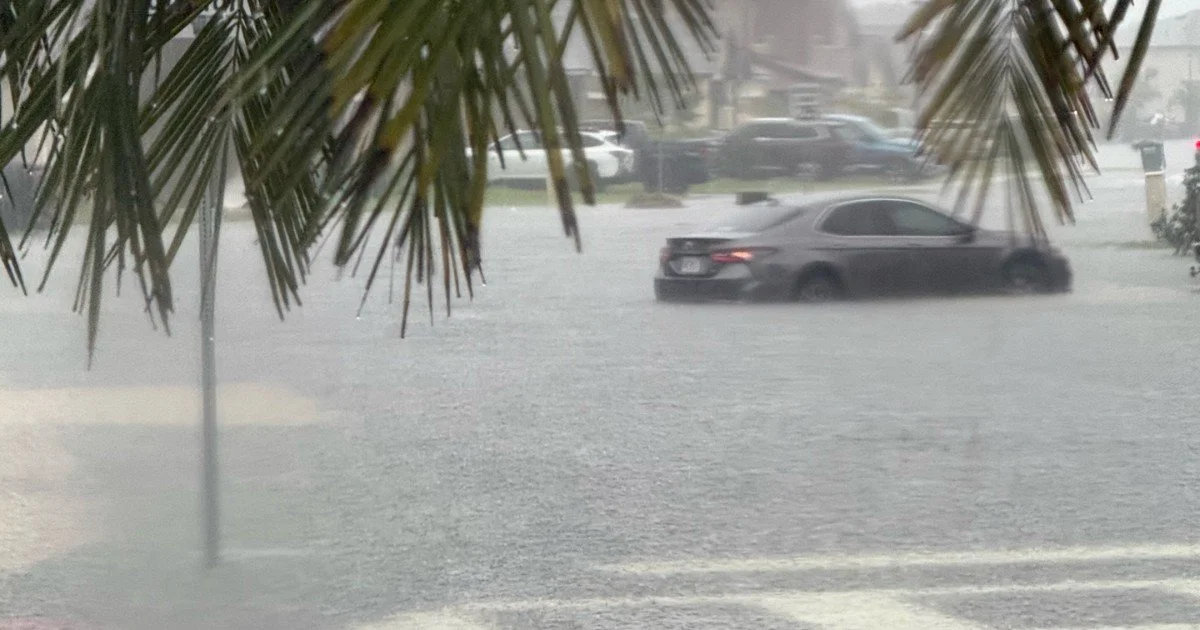

Two men are dead and about 2,000 Space Coast residents have reported flood damage. Federal help can't start until the governor asks for it. His record says his own emergencies come first.
By Joseph Jackson | Florida Man News Network | Opinion | Nov. 9, 2026
On Friday evening, Nov. 6, President Trump stood at Kennedy Space Center and talked about the moon. About 30 miles south, Palm Bay was holding information sessions for people whose homes had just been swallowed by a 1-in-1,000-year rain.
Plenty of people are mad at Trump for that, and the optics were ugly. But if you want to know why Brevard families still have no FEMA help a week after the water came up, don't look at the rocket podium. Look at Tallahassee.
What happened
From Nov. 1 to Nov. 2, nearly 24 inches of rain fell near Malabar and about 20 inches fell on Palm Bay. The National Weather Service declared a Flash Flood Emergency for West Melbourne and Palm Bay. Two men died: Joshua Bennett, 34, and Archie Richards, 74. Palm Bay Fire Rescue says its crews rescued roughly 1,400 people. Port Malabar Boulevard collapsed. Brevard emergency managers say about 2,000 residents have reported damage to their homes and property.
Most of those people won't get a check from an insurer. Only about 16% of Florida households carry flood insurance, according to AM Best. For everyone else, FEMA Individual Assistance is the backstop for rent, repairs and replacing what the water took.


Who has to ask
The process is not a mystery. The county finishes damage assessments. FEMA and the Florida Division of Emergency Management do joint assessments. Then the governor submits a request for a major disaster declaration, and the White House decides. No request, no FEMA money. Palm Bay's emergency preparedness coordinator told WFTV the city needs "money and resources that we don't have."
Ron DeSantis signed a state emergency order (EO 26-227) on Nov. 2 covering seven counties. Then the state sent his lieutenant governor, Jay Collins, to Palm Bay to look around and thank first responders.
A week later, nobody can tell a flooded family when the request will go to Washington. That's DeSantis's job. He has done it fast before; in 2023 he asked for a declaration for Broward's floods. The question for Brevard is simple: where's ours?
FMNN did not ask the governor's office for comment. If a request for Brevard had gone to Washington, you'd expect the governor to be announcing it. As of Monday night, we found no announcement.
Where the emergency money went
This is the part that should make every Space Coast voter angry, whatever their party.
In 2022, the Legislature created the Emergency Preparedness and Response Fund so the governor could pay for hurricanes and other disasters quickly, without waiting for lawmakers. DeSantis declared illegal immigration a state emergency and has renewed that declaration every 60 days since January 2023, more than 20 times. That kept the fund open for his own priorities.
When Alligator Alcatraz opened in the Everglades in July 2025, the fund held about $187 million. By January 2026, the state reported spending $573 million from emergency accounts on immigration enforcement, including Alligator Alcatraz and a second camp, Deportation Depot. The bills covered detention contractors, flights, restaurant tabs and lawyers to defend the camps in court. The state's own estimates had the two camps costing more than $1.7 billion through mid-2027.
DeSantis promised Washington would pay Florida back. Florida asked for $608 million. As of late May, it had received $58 million.
It got so bad that DeSantis's own Republican Legislature put guardrails on the fund in March. The fund was barred from new contracts in February, and in June DeSantis signed a bill to bring it back. That bill let the state pay off the rest of its immigration bills, including more than $600 million owed to the contractors who built and ran the camps.
Alligator Alcatraz closed on June 25, 2026, after one year. DeSantis said it had "fulfilled the role it was designed to serve."
So here's a fair question for the governor. The fund was designed for nights like Nov. 2. What role is it playing in Palm Bay?
The bottom line
DeSantis can move fast when he wants to. He built a detention camp in the Everglades in about a week. He renewed a paperwork emergency more than 20 times to keep the money flowing to it.
The water in Palm Bay was real. The deaths were real. The 2,000 damage reports are real. If the governor can find hundreds of millions for a camp that closed after a year, he can find the time to send one letter to Washington for Brevard.
And if you live on the Space Coast, remember who you were waiting on.
Sources
Florida Today via Yahoo News, "No FEMA help yet as Brevard families struggle for aid after floods" — https://www.yahoo.com/news/us/articles/no-fema-help-yet-brevard-100442463.html
WFTV, Brevard County pushes for federal aid — https://www.wftv.com/news/local/brevard-county-pushes-federal-aid-after-historic-flooding-damages-thousands-homes/GDXAHXI6E5BO3D2G4LPM7NEZBU/
Spectrum News 13, Palm Bay begins recovery — https://mynews13.com/fl/orlando/weather/2026/11/06/palm-bay-begins-recovery-efforts-as-floodwaters-recede
Spectrum News 13, Palm Bay Estates washout — https://mynews13.com/fl/orlando/news/2026/11/04/road-washed-out-in-palm-bay-estates-during-heavy-flooding
The Watchers, rainfall totals and EO 26-227 — https://watchers.news/2026/11/03/florida-declares-emergency-after-catastrophic-flooding-in-southern-brevard-county/
Insurance Journal, 1-in-1,000-year event and flood insurance — https://www.insurancejournal.com/news/southeast/2026/11/04/891513.htm
ClickOrlando, Lt. Gov. Collins in Palm Bay — https://www.clickorlando.com/news/local/2026/11/03/flooding-leaves-2-dead-massive-sinkholes-and-damaged-homes-in-palm-bay/
The Hill, Trump at Kennedy Space Center — https://thehill.com/video-clips/6204918-watch-live-donald-trump-florida-nasa-space-center-midterms/
Florida Phoenix via News From The States, Alligator Alcatraz closes — https://www.newsfromthestates.com/article/desantis-hails-alligator-alcatraz-victory-while-confirming-its-shutdown
Florida Phoenix via News From The States, emergency fund restored — https://www.newsfromthestates.com/node/414762
Florida Phoenix, first $58 million reimbursed — https://floridaphoenix.com/briefs/trump-admin-pays-florida-first-58-million-in-alligator-alcatraz-reimbursements-state-says/
Washington County News, $573 million on immigration — https://washingtoncounty.news/?p=13913
CiberCuba, emergency renewed 20+ times — https://en.cibercuba.com/noticias/2026-05-17-u1-e43231-s27061-nid329524-florida-gasto-458-millones-fondos-emergencia
Newsweek, where the fund's money went — https://www.newsweek.com/alligator-alcatraz-closes-leaving-floridas-disaster-funding-drained-12119878
Orlando Weekly / Florida Phoenix, $1.7 billion projection — https://www.orlandoweekly.com/?p=411802
WUSF / Florida Trib, Legislature curbs emergency powers — https://www.wusf.org/local-state/2026-03-15/gop-controlled-legislature-curtails-governors-emergency-powers-after-alligator-alcatraz-spending-spree
Florida Governor's Office, 2023 Broward request — https://www.flgov.com/eog/news/press/2023/governor-ron-desantis-request-major-disaster-declaration-response-southeast-florida
Share photo: Flooding in Grant-Valkaria, Brevard County, Nov. 2, 2026. Photo by WeatheredAviation via Wikimedia Commons, CC BY 4.0, cropped.