
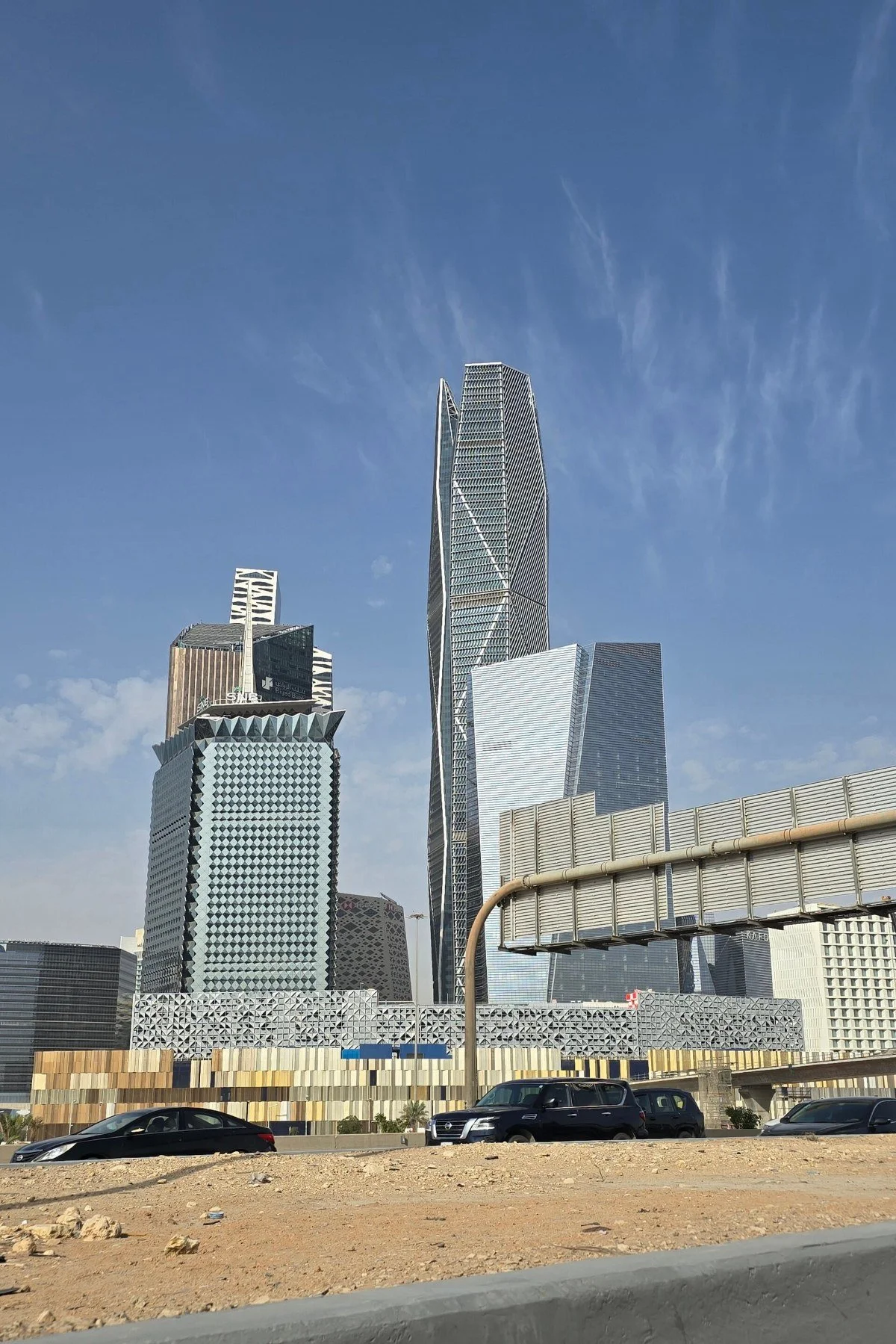

It's the second Riyadh landmark hit this month. Here's where the Iran war stands, and how Tehran and the Houthis work together.
By Joseph J. Jackson | ST. PETERSBURG (Nov. 20, 2026)
Update, Nov. 20, 2026: The Houthis claimed the strike late Thursday and warned foreign investors to leave Saudi Arabia. Details below.
The short version
A suspected Houthi missile hit the Public Investment Fund tower, Riyadh's tallest skyscraper and home of Saudi Arabia's roughly $1 trillion sovereign wealth fund, around 5 a.m. Thursday Riyadh time (9 p.m. Wednesday in Florida). No injuries were reported.
It follows the Nov. 8 hit on Aramco's tower a few blocks away. The Houthis are now striking the symbols of Saudi money, not just airports and oil sites.
The Iran war is heating back up: U.S. strikes on Iran's Qeshm Island, Iranian attacks on U.S. bases in Bahrain and Kuwait, tankers hit in the Strait of Hormuz, and reports that a new U.S. bombing campaign is increasingly likely. On Thursday, the Senate voted 48-51 against making Trump end the war or get Congress's approval.
Iran arms, trains and helps aim the Houthis, according to Wall Street Journal and Reuters reporting. Both deny it. The goal, regional sources say: squeeze Saudi Arabia until it leans on Trump to ease the U.S. blockade on Iran.
People in Riyadh woke up to a massive explosion around 5 a.m. Thursday, Middle East Eye reported.
By daylight, the 80-story Public Investment Fund tower, the tallest building in the Saudi capital, had blown-out windows across seven or eight floors and part of its metal facade bent, according to a Reuters journalist. Crews were already replacing glass.
Saudi authorities called it a terrorist attack by the Houthi militia. The Saudi-led coalition said it had dealt with an incoming missile and that debris fell, causing material damage but no injuries. Three people familiar with the matter told Reuters a Houthi missile hit the building. Debris from the same attempted strike also damaged a Saudi Aramco building in the city.
Later Thursday, the Houthis claimed it. Military spokesman Yahya Saree said on X that they had struck Riyadh's financial district twice, first before dawn and again later in the day. He also listed King Khalid International Airport, the Sadaf petrochemical company in Jubail and an air base at Khamis Mushait, and told foreign investors to leave Saudi Arabia immediately.
Didn't this just happen?
Yes. Eleven days earlier.
On Nov. 8, an attack claimed by Houthi military spokesman Yahya Saree damaged Aramco's 36-story corporate tower in the same district, the King Abdullah Financial District, shattering windows across several floors. Saudi Arabia's Energy Ministry called it "limited damage" from debris.
The pattern is the point. The PIF tower is the headquarters of the fund paying for Crown Prince Mohammed bin Salman's plan to remake the Saudi economy. The financial district is the showroom for investors. Hitting it tells the world Riyadh isn't a safe place to park money.
The same day, the crown prince met Adm. Brad Cooper, commander of U.S. Central Command, in Riyadh. CENTCOM is headquartered at MacDill Air Force Base in Tampa. Middle East Eye reported earlier that dozens of U.S. military advisers had arrived in Riyadh to help with air defense.
How bad has the Saudi–Houthi war gotten?
Bad, and getting longer.
At least 26 people have been killed in suspected Houthi drone and missile attacks inside Saudi Arabia since Sept. 23, according to Saudi authorities, as reported by Al Jazeera.
Riyadh's airport is the most-hit target. The Houthis claimed attacks on it on eight days in October and six so far in November, Reuters reported.
On Tuesday, the Saudi-led coalition launched a major air assault on Houthi-held Yemen and said it destroyed 60 military targets. Houthi officials said at least 17 people were killed.
In Yemen, more than 1,600 people have been killed and more than 300,000 displaced in the latest fighting, according to the UN. The Houthis are pushing toward Aden, the temporary capital of the Saudi-backed government.
Diplomats say Saudi Arabia isn't interested in talks and is preparing for the war to run into 2027.
Where does the Iran war stand?
It's nearly nine months old, and the ceasefire is barely breathing.
How we got here:
Feb. 28: The U.S. and Israel launch strikes on Iran. Supreme Leader Ali Khamenei is killed; his son Mojtaba Khamenei replaces him. Iran fires missiles and drones at Gulf states that host U.S. bases, including Saudi Arabia.
April 8: A two-week ceasefire.
June: A preliminary deal and talks in Switzerland and Doha. The ceasefire that followed lasted less than three weeks.
Before Election Day: Talks fell apart. Weeks of indirect talks since have gone nowhere.
This week:
Tuesday, Nov. 17: The U.S. struck military targets on Iran's Qeshm Island in the Strait of Hormuz. A tanker was hit by a projectile in the strait and caught fire. A third U.S. aircraft carrier arrived in the region.
Wednesday, Nov. 18: Bahrain and Kuwait said they intercepted Iranian drones and missiles. The U.S. said it was Iran's third attempt in five days to hit a U.S. military base. An ADNOC ship was struck, leaving 11 injured and a crew member missing. Trump told Fox News Iran may be working on chemical or biological weapons.
Thursday, Nov. 19: Bloomberg and The New York Times reported new U.S. strikes are increasingly likely, with Israeli Prime Minister Benjamin Netanyahu pushing for a four-to-seven-day campaign. Trump said he's "not rushing" and might wait until after the new year. Iran's Revolutionary Guards claimed two more tankers hit mines; claims like that often go unconfirmed.
Also Thursday: The Senate voted 48-51 against a war powers resolution that would have directed Trump to pull U.S. forces from hostilities with Iran. Republicans Susan Collins, Lisa Murkowski and Rand Paul voted for it; Democrat John Fetterman voted against. It was the Senate's first major vote on the war since the midterms. The House passed the resolution in September.
What it's costing: A Pentagon official put the war's price tag at $48.3 billion. The International Energy Agency called the crisis the largest threat to energy security in history. Congress has never authorized this war.
How do Iran and the Houthis work together?
Think of it as one squeeze with two hands.
Two chokepoints. Iran threatens the Strait of Hormuz at the top of the Gulf. The Houthis threaten Bab el-Mandeb at the bottom of the Red Sea. Most Gulf oil has to pass one or the other. Squeeze both and the whole world pays at the pump.
Saudi Arabia is the pressure point. Iran can't force Washington to lift its blockade, so it's raising the cost on America's partners instead, Reuters reported in October, citing Saudi, Iranian and regional sources. By hitting airports, oil sites and investment showcases, the Houthis aim to push the crown prince to give them what they want in Yemen and to lean on Trump to ease the blockade on Iran. Analyst Michael Knights put it bluntly: they're "hammering the weak point."
The Houthis have their own list. Regional sources told Reuters the Houthis want Saudi military operations stopped and restrictions on Yemen's ports and airports lifted. They aren't just taking orders. They do have a direct interest, though: Iran is their main backer, and a choked Iran can send less money and fewer weapons.
The pipeline. The Wall Street Journal reported in October that Iran's Revolutionary Guards helped the Houthis seize ground in western Yemen and launch their most advanced attacks yet on Saudi Arabia, according to reporting summarized by Al Jazeera. That help reportedly includes training, intelligence and help aiming drones and missiles. The Journal reported that Iranian Mahan Air flights carried Revolutionary Guards officers, drone parts, missile guidance systems and detonators, and that officers directed attacks from the front lines.
The coalition's spokesman said an "external state actor" is behind the Houthis' weapons, without naming Iran. Iran and the Houthis both deny the Revolutionary Guards link. The Houthis say they build their own weapons.
Building at home. New research reported by The New Arab says the Houthis are trying to make parts of advanced Iranian-designed ballistic missiles inside Yemen. They still depend on imports for key parts of the most advanced weapons.
Russia in the background. An investigation reported by Al Jazeera in October found Russian satellites helping the Houthis target Saudi military and energy sites.
The deal that died. In 2023, Saudi Arabia and Iran restored relations in a deal brokered by China, after Iran agreed to stop arming the Houthis. That deal is now dead in all but name. Iran even offered in October to mediate between Saudi Arabia and the Houthis, the group it's accused of arming.
What happens next?
Three things to watch:
Whether Trump greenlights the new bombing campaign Netanyahu wants, and whether Iran answers through the Houthis.
What the Houthis hit next in Riyadh, now that they have told foreign investors to leave.
Whether Saudi Arabia, now buying more air defense and hosting U.S. advisers, gets pulled further into the U.S. war on Iran.
Every one of those runs through CENTCOM, headquartered in Tampa. This war isn't as far away as it looks.
FMNN will update this story as the Houthis, Saudi Arabia or the Pentagon say more on the record. Read our earlier Iran war coverage.
Sources
Middle East Eye, "Houthis hit Saudi Arabia's sovereign wealth fund skyscraper," Nov. 19, 2026
Reuters via Al-Monitor, "Factbox: Houthi attacks on Saudi Arabia," Nov. 19, 2026
Reuters via U.S. News, "Factbox: Houthi Attacks on Saudi Arabia," Nov. 19, 2026
Express Tribune (agencies), "Houthi attack damages Aramco tower in Riyadh," Nov. 9, 2026
Al Jazeera, "Saudi-led coalition intercepts suspected Houthi missiles and drones," Nov. 15, 2026
The Hill, "Senate Republicans reject war powers resolution to end Iran war," Nov. 19, 2026
ABC News, "Iran live updates: Republicans block war powers resolution," Nov. 19, 2026
The New Arab, "The Houthi war machine is evolving. Can Saudi Arabia keep pace?" Oct. 21, 2026
Al Jazeera, "Are Houthis using Russian satellites as Saudi Arabia fends off strikes?" Oct. 31, 2026
Reuters via GV Wire, "Missile hits headquarters of Saudi Aramco, source says," Oct. 13, 2026
TASS, "Houthis claim strikes on four sites in Saudi Arabia, warn investors," Nov. 19, 2026