
EXPLAINERS | ENCRYPTION, PART 1 OF 3
A rumor this week said AI broke the internet’s locks. Before you can judge that, you need to know what the lock is and where you’re already using it.
By Joseph J. Jackson | ST. PETERSBURG, Fla. (Nov. 25, 2026)
The short version
Encryption scrambles information so only someone with the right key can read it. The method is public. Only the key is secret.
There are two kinds of lock. One uses a single shared key. The other uses a pair: a public key anyone can see and a private key only you hold.
You use both dozens of times a day. The rumors about AI and quantum computers are aimed at the two-key kind.
On Tuesday night, a rumor went around that artificial intelligence had cracked the locks that protect the internet. By Wednesday it had tens of thousands of views.
Most people sharing it couldn’t tell you what the lock is. That isn’t an insult. Nobody taught us. So before FMNN tells you what’s true about the rumor, I’m going to show you the lock.
What is encryption?
Encryption takes something readable and scrambles it into nonsense. The right key turns it back. Without the key, all anyone sees is noise.
Here’s the part that surprises people. The scrambling method isn’t a secret. The government publishes it. Anyone can read exactly how it works. The security comes from one thing only: the key.
A key is just a number. A very, very big one.
How does a one-key lock work?
Think of a safe with one combination. I lock it with the combination. You open it with the same one.
That’s the first kind of encryption. Both sides hold the same key. It’s fast, and it’s what scrambles the actual data when you load a web page or save a file.
How strong is it? The standard version has more possible keys than a 77-digit number can count. Guessing isn’t a plan.
It has one weakness. You and I both need the combination. If we’ve never met, how do I get it to you without somebody listening?
How does a two-key lock work?
For most of history that question had no answer. Then, in 1976, mathematicians found one, according to the National Institute of Standards and Technology.
Picture a mailbox on the street. Anyone can drop a letter in the slot. Only the person with the mailbox key can take letters out.
That’s a two-key lock. You get a pair of keys tied together by math. The public key is the slot. You hand it to the whole world. The private key opens the box, and it never leaves your hands.
Two total strangers can now talk in private. That is how you can buy something from a store you’ve never walked into.
Why can’t someone work backward from the public key?
Because the math only runs one way.
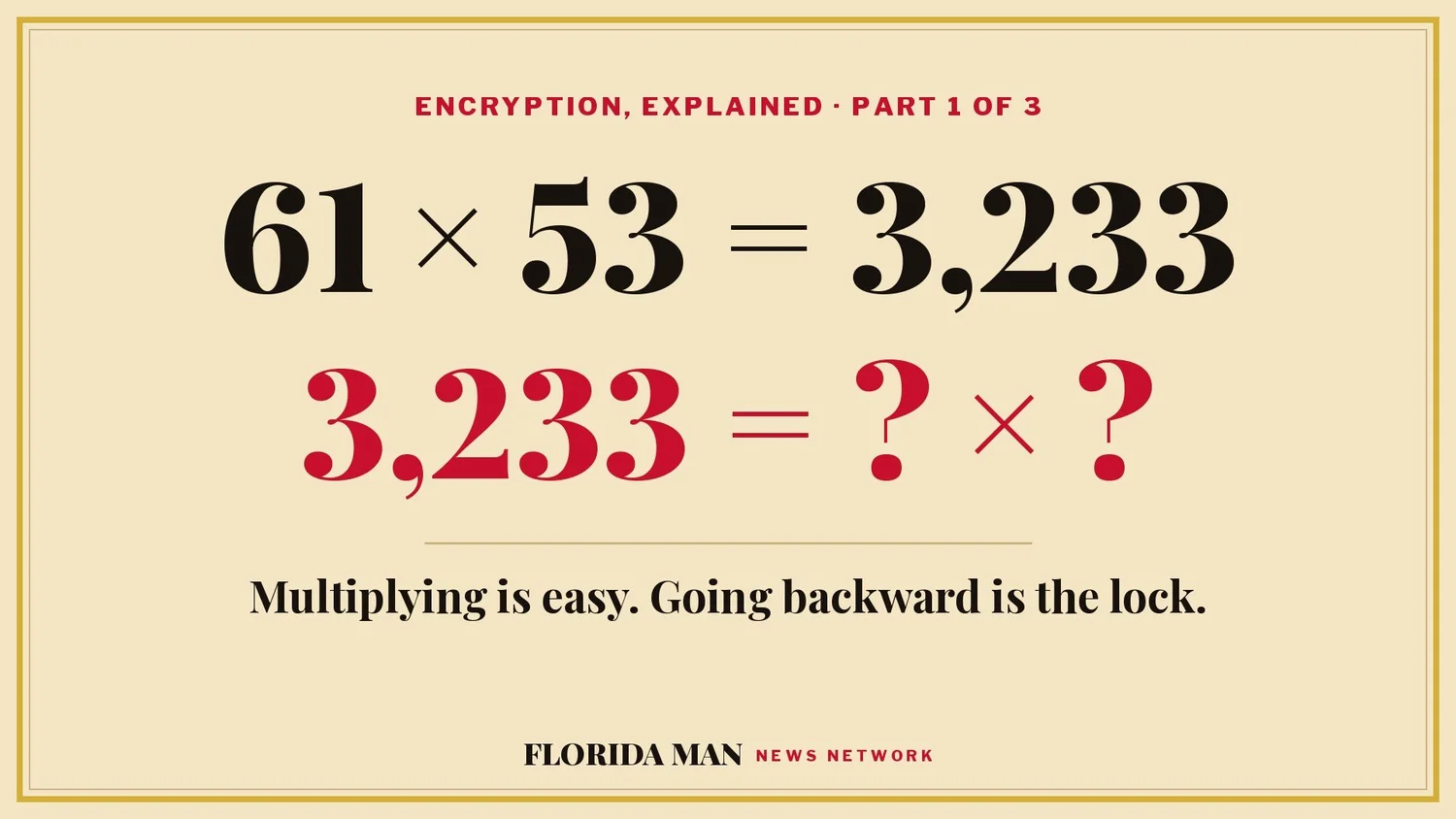
Try it. Multiply 61 by 53. You can do that on a napkin: 3,233. Now go the other way. I hand you 3,233 and ask which two numbers I multiplied. You’d have to hunt.
Now make the numbers 300 digits long each. Multiplying them still takes a computer no time. Going backward would take ordinary computers longer than any of us will be alive.
One of the main two-key locks, called RSA, is built on that exact gap. The other main one, used by your phone and by Bitcoin, is built on a different one-way problem involving curves.
Hold onto that phrase: one-way. Every scary headline about encryption is somebody claiming to have found the way back.
What is a digital signature?
Run the two-key lock in reverse. I scramble something with my private key. Anyone can check it with my public key. If it checks out, it came from me, and nobody changed it along the way.
Signatures lean on one more tool, a fingerprint. A fingerprint formula boils any file down to a short code. Change one comma in the file and the code comes out completely different.
Where is it in my day?
Everywhere, and mostly out of sight.
Opening your bank’s website. The padlock in the address bar. A two-key lock proves the bank is the bank, then a one-key lock scrambles the visit.
Tapping your card at the register. The chip signs each purchase with its own key.
Getting a software update. A signature proves it came from the phone’s maker and not a thief.
Messaging in iMessage, WhatsApp or Signal. Two-key locks set it up so only the two phones can read it.
Sending a plain text message. No lock. Carriers can read it.
Logging in with a password. A well-run site stores only the fingerprint of your password, never the password.
Losing your phone. The storage is scrambled with a one-key lock tied to your passcode.
Holding Bitcoin. Your “wallet” is a private key. Whoever has the key has the coins.
When you open your bank’s site, both locks work as a team. The two-key lock goes first, and then the fast one-key lock takes over, as Cloudflare’s explainer lays out. It all happens before the page finishes loading.
Why does this matter this week?
Because the rumor, and the quantum computers behind the federal deadlines, are aimed at the two-key locks. Those are the ones that prove who’s who. Look back at that list and count how many depend on them.
That’s the lock. Tomorrow morning: how people break it.
Next, Part 2: How Do You Break a Lock Made of Math?
Disclosure: FMNN uses Claude, an AI model made by Anthropic, to help research and draft stories. Every story is edited and approved by Joseph J. Jackson.
Sources
National Institute of Standards and Technology, Cryptography
Cloudflare Learning Center, “How does public key cryptography work?”
Quanta Magazine, “How Public Key Cryptography Really Works,” Nov. 15, 2024
Graphic and video: FMNN. Video narration is AI-voiced.