
OPINION · By Joseph J. Jackson | ST. PETERSBURG (Nov. 17, 2026)
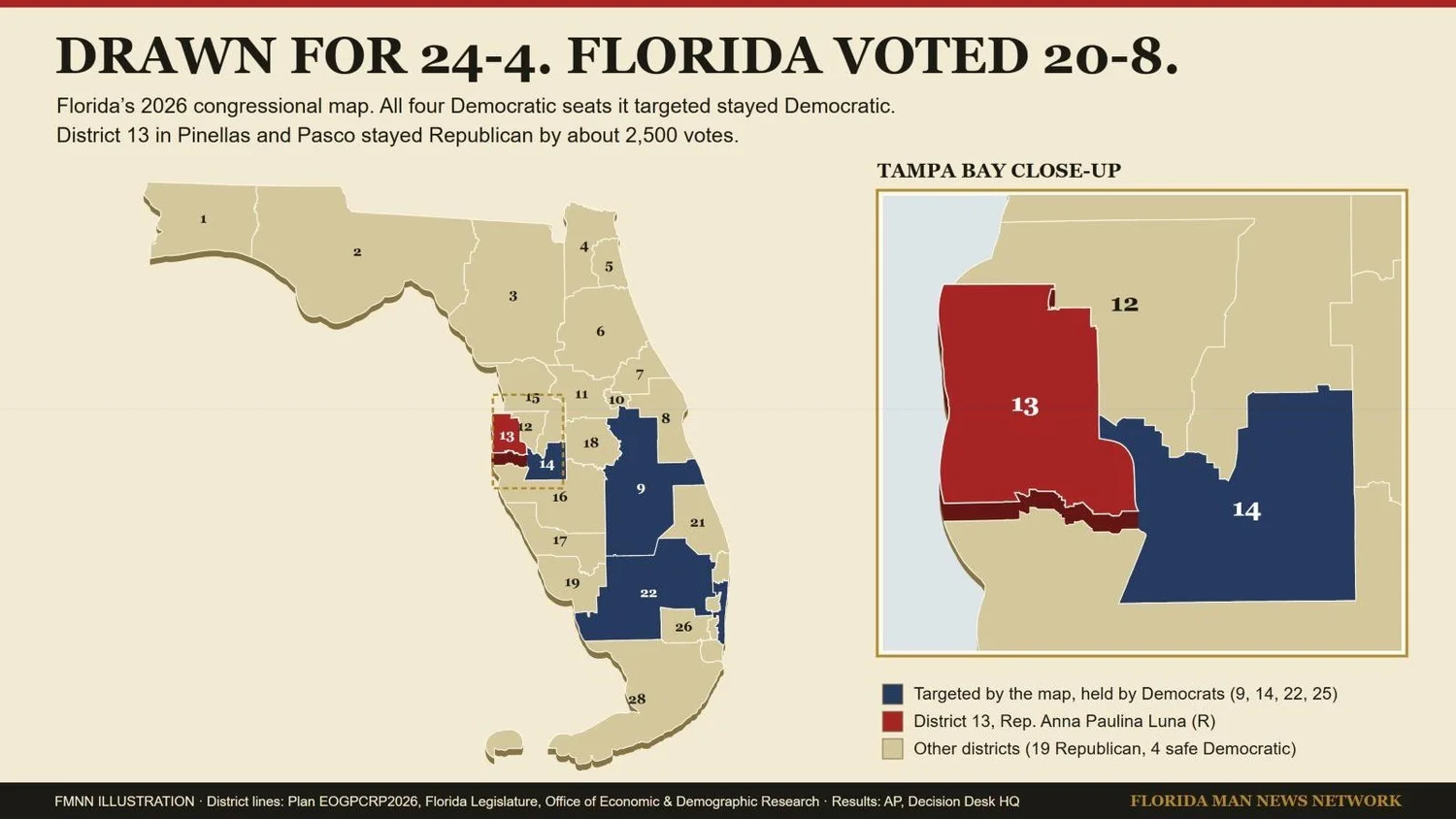
Florida's Supreme Court threw out districts drawn to help a party in 2015, including the Pinellas seat Anna Paulina Luna just held by about 2,500 votes. Now the governor is bragging about what his new map was worth.
Short version
In 2015, Florida's Supreme Court threw out eight congressional districts for being drawn to favor one party. One of them was the Pinellas seat, District 13.
In 2026, the governor's mapmaker admitted to lawmakers that he used partisan data. They voted not to put him under oath.
Breaking Fair Districts carries no penalty. The worst case is a redraw, years later.
After the election, DeSantis posted that the old map would have elected 18 Republicans and the new one elected 20. He also credited a property tax amendment he pushed onto the ballot with turning out Republican voters.
No court has ruled on whether the 2026 map is legal. It was used anyway, and Luna won District 13 under it by about 2,500 votes.
On July 9, 2015, the Florida Supreme Court looked at the congressional map the Legislature drew in 2012 and called it what it was. In a 5-2 ruling, the justices agreed the map was tainted by intent to favor a party, and ordered eight districts redrawn.
Two of those eight were right here. One was Kathy Castor's Tampa seat. The other was the Pinellas district then held by David Jolly, a Republican. District 13. The same number Anna Paulina Luna holds today.
Eleven years later, Pinellas is back in a gerrymandered map. The only thing that changed is who's pretending the rule doesn't exist.
What did Florida voters actually ban?
In 2010, Florida voters wrote the Fair Districts Amendments into the state constitution. The rule is short: no district may be drawn with the intent to favor or disfavor a political party or an incumbent.
The 2015 case, League of Women Voters of Florida v. Detzner, was the first real test of that rule. It set two things that still matter.
First, intent can be proven. The court affirmed that both the 2012 "redistricting process" and the "resulting map" were tainted by partisan intent.
Second, once a court finds that intent, the burden flips. The Legislature has to justify its lines. Voters don't have to keep proving the rigging.
That is Florida law. It has not been overturned.
How was the 2026 map drawn?
I read the record. Here is what's in it.
DeSantis's office announced the Fair Districts Amendment was illegal before any court said so. Then it released a map drawn in secret.
The map went to Fox News before the Legislature saw it.
The Legislature passed it on April 29. The House vote was 83-28. The Senate vote was 21-17, with four Republicans voting no.
DeSantis signed it May 4. It reworked 21 of Florida's 28 districts.
The governor's aide Jason Poreda told lawmakers he was the only map drawer. In public committee testimony, he admitted he used partisan data. He said it was one factor and not his main concern.
Poreda said he consulted other DeSantis staffers. He wouldn't name them.
The House Redistricting Committee voted against putting him under oath.
In court, plaintiffs pointed to his statements that he drew the map "not having to comply with the Fair Districts Amendment."
In 2015, the court had to dig through consultants' emails to find the intent. In 2026, the mapmaker said it out loud.
Then why wasn't it stopped?
Because no court has ruled on whether it's legal. Every ruling so far has been about timing.
A Leon County circuit judge, Joshua Hawkes, appointed by DeSantis, refused to block the map in May. He wrote that "the potential partisan intent in the 2026 map is the lesser of the two evils."
Read that again. A judge didn't say the map was clean. He said the partisan intent was the smaller problem.
On June 10, the Florida Supreme Court voted 6-1 not to step in. The majority said it lacked jurisdiction while the case sits in the First District Court of Appeal. Justice Jorge Labarga dissented, writing that the 2026 elections affecting millions of Floridians met the bar to act.
So the case is still pending. The map was used anyway. That's not a court saying the map is legal. That's the clock running out.
What did the map do here?
The new lines moved District 13 north into Pasco and made it about a point more Republican.
Luna won 155,117 votes to Leela Gray's 152,600, a margin of about 2,500. That's less than 1 percentage point.
Statewide, the map was built to turn a 20-8 Republican delegation into 24-4. It didn't get there. The map targeted four Democratic seats: Districts 9, 14, 22 and 25. Democrats held all four, including Kathy Castor's District 14 right next door in Tampa. Florida's delegation stayed 20-8.
DeSantis doesn't call that a miss. He calls it a save.
What is DeSantis saying now?
The day after the election, he stood in Tallahassee and called the national results "the political equivalent of a meteor strike." Florida, he said, was the one state that held the line.
Then he told everyone how.
The map. On Nov. 13, he posted on X: "Florida would have elected 18 Republicans and 10 Democrats under the old map." Under the new one, he wrote, Florida elected 20 Republicans and 8 Democrats.
That's the governor counting, in public, the seats his map was worth to his party. Two of them.
Florida voters wrote one rule in 2010: no district drawn to favor a party. The 2015 court enforced it. DeSantis is now posting the scoreboard for breaking it.
The amendment. DeSantis pushed lawmakers to put Amendment 3, a homestead property tax cut, on the November ballot. It passed with nearly 62%. Turnout hit 60.9%, the second highest for a Florida midterm in 30 years.
Afterward, he gave it credit for more than tax relief. "I don't know that we turn out the voters that we ended up turning out," he said of a ballot without it. And voters who came for the amendment, he said, "ended up voting Republican later on down the ballot."
Let's be clear about which part is illegal. Putting a popular measure on the ballot to pull voters out isn't against the law. Both parties do it. It's politics, and DeSantis said the quiet part out loud.
The map is different. The Florida Constitution bans drawing lines to favor a party. The man who drew the lines is now bragging that they favored his party.
So was the election illegal?
No. Be careful with that word.
The votes were cast and counted under a map that was in force. Luna won the count. Gray hasn't filed a challenge that I can find, and the margin was outside Florida's recount range.
The fair question is about the lines, not the ballots. History shows how this goes. The 2012 map was used in 2012 and 2014. Those results stood. The court's fix came for 2016.
If the courts apply 2015 law to the 2026 map, the fix comes for 2028, not by unseating anyone this year.
Why does breaking this rule cost nothing?
Here's where the law and the harm stop matching.
Florida voters passed Fair Districts with 63% of the vote. The harm it targets is deliberate: taking away a community's voice in Congress so one party keeps power. That's not an accident or a paperwork error. It's done on purpose, by people who know the rule.
But the rule has no penalty. No fine. No jail. No removal from office. If a court finds a map illegal, the only remedy is a new map. That comes years later, after elections have already been held under the bad one.
So the math is simple. Break the rule, win the seats, and run out the clock. If you lose in court, you redraw. That's the worst case.
DeSantis's Nov. 13 post shows he's done that math. He's counting the seats while the case sits undecided.
Federal court won't help either. In 2019, in Rucho v. Common Cause, the U.S. Supreme Court said partisan gerrymandering claims are not for federal courts. That leaves state courts, and a state rule with no teeth.
Could anyone face charges?
Not for the gerrymander itself. Drawing an illegal map isn't a crime under Florida law. That's the gap.
But the process around it touches laws that do carry penalties. These are questions, not accusations. No one has been charged with anything.
Testimony. Perjury in Florida requires an oath. When the House committee voted not to swear in the mapmaker, it took perjury off the table for anything he told lawmakers. Ask why they voted that way.
Public records. The drafts, emails and notes behind a map drawn in the governor's office are public records under Chapter 119. Who helped draw it is a public question. A public officer who knowingly breaks the records law commits a crime.
The Sunshine Law. It covers meetings between members of the same board, like legislators on the same committee. It doesn't cover staff working privately in the governor's office. That's how a map can be "drawn in secret" without breaking it.
The harm was intended. The law punishes almost none of it. That's the real scandal.
What would fix it?
The 2027 session starts in the spring. Here's what lawmakers could file:
Sworn testimony. Anyone presenting a map to the Legislature testifies under oath. No vote needed.
Open drafts. Every draft map and every person who worked on it goes public before a vote.
No map without a ruling. If a map is challenged under Fair Districts, courts must rule on the merits before it's used, or the old map stays.
Real consequences. A finding of intentional partisan intent triggers a penalty, not just a do-over.
FMNN's Legislature watch group will track whether anyone files them, and who votes no.
Their side
DeSantis's office says the old map was the real problem. After the U.S. Supreme Court's ruling in Louisiana v. Callais, it argues that race-based districts like South Florida's District 20 can't stand, and that part of the Fair Districts Amendment conflicts with the U.S. Constitution. Judge Hawkes agreed that the race concern outweighed the partisan claims.
That argument is about one district in South Florida, built around race. It doesn't explain why Tampa Bay was redrawn, or why the mapmaker used partisan data at all. Callais said what map-drawers can't do with race. It didn't give them permission to do what Florida voters banned with party.
What happens next?
The case, Equal Ground Education Fund v. Byrd, now combined with two other challenges, is still in the First District Court of Appeal. When it's decided, it can go to the Florida Supreme Court.
In 2015, that court said partisan intent "is contrary to the very purpose of the Fair Districts Amendment." The question now is whether today's court still means it.
Florida voters wrote the rule. The court enforced it once. Pinellas got its fair lines back once already.
We shouldn't have to win the same fight twice. But we will.
Joseph J. Jackson is the founder of Florida Man News Network and author of the four-volume Death of the American Dream. Opinions are his own.
Sources
Florida Supreme Court, League of Women Voters of Fla. v. Detzner, SC14-1905 (July 9, 2015).
Florida Supreme Court, remedial map opinion (Dec. 2, 2015).
Fox 13: the 2015 ruling's Tampa Bay districts.
CBS Miami: the 2015 ruling.
Campaign Legal Center: Thompson-Wynn v. Byrd.
WUSF: breakdown of the 2026 map.
Washington Examiner: Legislature votes (Apr. 29, 2026).
Florida Trib: Poreda's testimony (Apr. 30, 2026).
ClickOrlando: Poreda wouldn't name staffers (Apr. 29, 2026).
Equal Ground complaint via Democracy Docket: oath vote, Fox News release.
Common Cause Florida: Fair Districts passed with 63%.
Rucho v. Common Cause (2019).
Florida Statutes: ch. 119 (public records), s. 837.02 (perjury).
Axios: May 2026 hearing.
State Court Report: Judge Hawkes's ruling.
AP: Florida Supreme Court 6-1 and the Labarga dissent.
Democracy Docket: case docket.
Washington Times: District 13 result and redraw.
Bay News 9: District 13 vote totals.
ABC News: all four targeted Florida seats held by Democrats.
WCTV: delegation stays 20-8.
Gov. Ron DeSantis on X (Nov. 13, 2026).
WFLA: "meteor strike" press conference.
WFSU / News Service of Florida: turnout and Amendment 3.
Miami Times: DeSantis on Amendment 3.
CBS Miami: 60.9% turnout.
Florida Legislature, Office of Economic & Demographic Research: Plan EOGPCRP2026 official district file (map source).
Map: FMNN illustration. District lines: Florida Legislature, Office of Economic & Demographic Research (Plan EOGPCRP2026).