
Amendment 3 becomes law on Jan. 1. Gov. Ron DeSantis wants lawmakers back in Tallahassee before then to write its rules. The two men about to run the Legislature say it can wait until the next governor, Byron Donalds, takes over. Cities and counties facing billions in losses are stuck in between.
By Joseph J. Jackson | TAMPA BAY (Nov. 13, 2026)
The short version
DeSantis wants a special session before he leaves office to put Amendment 3 in place and keep local governments from making up the lost money with new taxes and fees.
Incoming Senate President Jim Boyd of Bradenton says it “can wait until we reconvene in January.” Incoming House Speaker Sam Garrison says he’d “rather be right than be quick.”
State economists project cities and counties will lose about $5 billion next year and roughly $46 billion over five years. Until the rules are written, local budget writers are guessing.
What DeSantis wants
The day after voters passed Amendment 3 with 62%, DeSantis said he would call lawmakers back for a special session and let legislative leaders pick the dates, CBS Miami reported. He wants it finished before the amendment takes effect. “That has to be done by January 1, and we will do it by January 1,” he said, the Florida Phoenix reported.
His main goal: stop cities and counties from “doing an end-run around the amendment and taxing them in other ways.” “They said it’ll be tax shift. It’s not going to be a tax shift,” he said, according to the Tallahassee Democrat. He has called Amendment 3 “the beginning of our property tax elimination efforts,” News4JAX reported.
DeSantis leaves office Jan. 5, four days after the amendment kicks in.
What the next leaders say
The two Republicans taking over the Legislature aren’t in a hurry.
Jim Boyd of Bradenton, the incoming Senate president, said in a podcast interview: “Personally, I believe that it can wait until we reconvene in January,” adding, “I think the new administration ought to have a say in that,” the Tallahassee Democrat reported. He has said much of what the Senate passed was “self-executing,” though some implementing language may still be needed.
Sam Garrison of Fleming Island, the incoming House speaker, called Amendment 3 “a very, very complicated issue” that “will dominate the upcoming session,” and said he’d “rather be right than be quick,” the Florida Phoenix reported. His allies say he wants Gov.-elect Byron Donalds to have a role.
Democrats don’t see a rush either. “I don’t know if there’s a necessity to do anything immediately about it,” said Rep. Christine Hunschofsky of Parkland, the incoming House Democratic leader. Rep. Anna Eskamani of Orlando called DeSantis “a lame duck” and said a new Legislature and governor should oversee it, Gulf Coast News reported. Former Republican state Sen. Jeff Brandes, who opposed the amendment, said an implementing bill could simply be the first bill of the 2027 session.
Boyd and Garrison take over at the Legislature’s organization session on Nov. 17. Committee hearings start the week of Nov. 30. The regular session starts in March.
RELATED: Florida’s New Legislature, by the Numbers: 70 Seats and Amendment 3 · Can Florida Stop Amendment 3? The Real Options, and the Odds
What’s actually at stake
Amendment 3 raises the homestead exemption on non-school property taxes from $50,000 to $150,000 in 2027, then to $250,000 in 2028. New Florida residents have to wait five years to get the bigger exemption.
State economists project cities and counties will lose about $5 billion in tax revenue next year, almost $12 billion a year by 2031 and roughly $46 billion over five years. County governments and the 100 largest cities lose more than 20% of their tax collections over five years, the Tallahassee Democrat reported.
The rules lawmakers write will decide things like:
Whether local governments can raise other taxes or fees to fill the hole. That’s the “end run” DeSantis wants blocked.
Whether the state sends any replacement money, especially to small and rural counties. Donalds has promised a funding formula for them. (More in our explainer.)
How “permanent residency” is proven for the five-year wait. That detail is still open.
What it means in Tampa Bay
Local budget offices have to plan next year’s spending around numbers Tallahassee hasn’t settled. Here’s where FMNN’s county coverage stands:
Pasco voted 67.1% yes and faces an estimated $1.43 billion five-year local loss. Its former sheriff, Chris Nocco, now votes on the rules as a state senator. Pasco’s Sheriff Goes to the Senate as the County Faces a $1.4 Billion Hit
Hernando voted 69.4% yes, the highest in Tampa Bay. Projected county loss: $36.9 million in year one, $73.6 million a year by 2031-32. Hernando Voted Hardest for Amendment 3. Its Budget Takes a Big Hit.
Polk voted 62.5% yes, and Sheriff Grady Judd is freezing hiring over an expected $102 million less over two years. Polk Flips a House Seat as Sheriff Judd Freezes Hiring Over Amendment 3
Hillsborough faced the same question before the vote: a tax cut with no replacement plan. Amendment 3: Tax Cut, No Replacement Plan
Libraries aren’t on the amendment’s protected spending list. “My Heart Is Broken”: Florida Library Association Vows to Fight On
And Amendment 3 hung over this week’s Rays vote, as residents on both sides raised it while Hillsborough set aside $90 million for a ballpark. Hagan Said No Stadiums With the Tax. Now $90 Million of It Goes to the Rays.
Boyd, the man who says the rules can wait, represents Manatee County, part of Tampa Bay.
Does it have to happen by Jan. 1?
Not necessarily. Florida has let amendments take effect before the rules were written. Amendment 4, the 2018 voting-rights measure, took effect in January 2019, but its implementing law wasn’t signed until June 2019, the Tallahassee Democrat noted. That law narrowed what voters approved, the fight FMNN laid out in Can Florida Stop Amendment 3?.
The governor can call a special session on his own. DeSantis has said he’ll let the Legislature choose the dates, and so far its incoming leaders haven’t picked any.
What to watch
Nov. 17: Boyd and Garrison take over as leaders. Watch what they say about a special session.
Whether DeSantis calls one anyway before he leaves Jan. 5.
Week of Nov. 30: first committee hearings. Any Amendment 3 bill language shows up here first.
Your county’s budget workshops. That’s where the cuts get named.
Call before the rules are written. Your state senator and House member decide this. Find yours in our county stories above, or at flsenate.gov and myfloridahouse.gov.
Sources
News4JAX, “DeSantis calls special session to implement Amendment 3 property tax cuts,” Nov. 4, 2026
County figures: FMNN’s Pasco, Hernando and Polk stories (Nov. 13, 2026), each with its own sources.
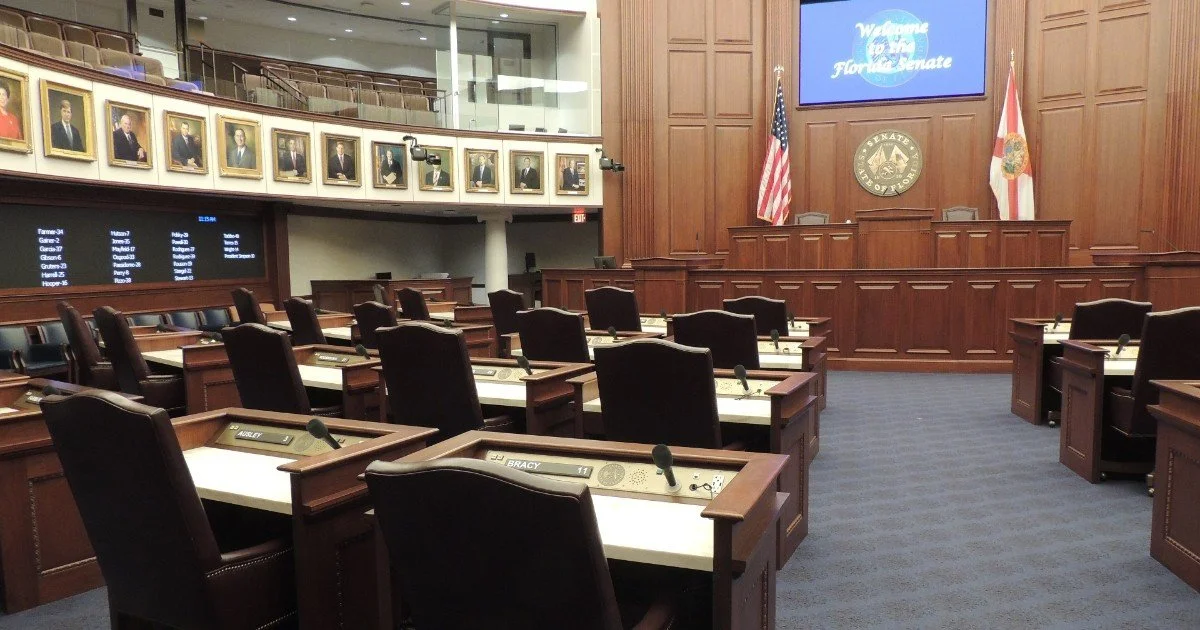
Photo: Florida Senate chamber, Florida Capitol, Tallahassee. Riis2602 via Wikimedia Commons, CC BY-SA 4.0 (cropped).
