
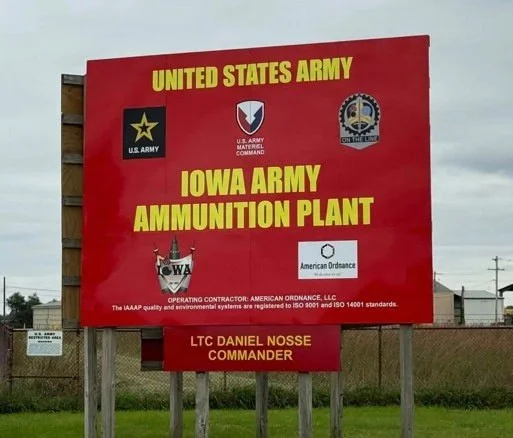
The Army's own model shows lead in the air from Burlington to north of the Quad Cities. It hasn't said how much is being blown up.
By Joseph J. Jackson | ST. PETERSBURG (Nov. 19, 2026)
The short version
The Army plans two controlled detonations of degraded lead azide, a toxic explosive, at the Iowa Army Ammunition Plant in Middletown, Iowa, at about noon Central on Friday, Nov. 20.
The plant's modeling shows possible elevated lead in the air across an area up to 20 miles wide, from Burlington to well north of the Quad Cities. Lead could settle on the ground across an area up to 10 miles wide.
The EPA permitted the detonation. The Army has told residents about air, soil and water testing. It has not publicly said how much lead azide is involved or why it can't be moved.
At noon Friday, the U.S. Army will set off two explosions in southeast Iowa. What goes up is lead.
The Iowa Army Ammunition Plant in Middletown announced the detonations in a Nov. 15 advisory. The Army calls it "a planned and controlled safety operation to dispose of the degraded lead azide." The EPA permitted it under the federal hazardous waste law, the Resource Conservation and Recovery Act.
The Army says the blasts will cause loud noise, ground vibrations and "a dust plume that will contain some lead."
How far could the lead go?
Farther than one neighborhood.
The plant's modeling predicts possible elevated levels of lead particles in the air across an area up to 20 miles wide, stretching from Burlington to well north of the Quad Cities, NPR Illinois reported Tuesday. Both Burlington and the Quad Cities sit on the Mississippi River.
Some lead could settle on the ground in an area up to 10 miles wide, from near Burlington to north of Wapello and New Boston. Much of that is farmland.
The Army says it will update its plume maps 48 hours before the blast, 6 hours before and hourly afterward, then publish a final estimate of the affected area.
Who is being told to leave?
The Army recommends that residents of the Middletown City Park neighborhood leave from 8 a.m. to 2 p.m. Friday, citing possible window damage. The Armed Forces Reserve Center in Middletown, at 16815 DMC Highway 34, will take residents and their leashed or crated pets.
The Army says the dust should linger for no more than an hour, depending on wind.
What should people in the plume area do?
The guidance published so far covers Friday only:
Avoid the area and skip unnecessary travel through it.
Stay indoors with windows and doors closed. Set heating and cooling to recirculate if it's safe.
After the Army says exposure has ended, clean indoor and outdoor surfaces, including children's play areas and windowsills.
Consider taking a car parked outside through a car wash.
Is anyone testing the land and water?
The Army says so. At an Oct. 15 open house at the Armed Forces Reserve Center, about 200 residents and local leaders heard from Army staff about sampling and testing of air, soil and water, "agricultural land stewardship" and post-detonation assessments, according to the Army's own account. A representative of the Army Corps of Engineers in Omaha collected 28 right-of-entry forms from homeowners there.
What the Army has not published is the plan itself: which farms, wells and waterways get tested, and when the public sees the results.
Why not just move it?
The record shows the Army and EPA have treated this waste as dangerous for months.
The EPA gave oral approval of an emergency permit on April 2, 2026, to store lead azide waste at a spot the plant's regular permit doesn't cover. A second and third emergency permit followed. The EPA describes the waste as reactive, meaning explosive, and toxic for lead. In a July 13 notice, it said the permits were needed to address "an imminent and substantial endangerment."
In short: officials consider the waste dangerous to leave where it is. The Army has not publicly explained why blowing it up in the open is the only option left.
This is not the plant's first problem with hazardous waste. In December 2024, the EPA fined the Army and its contractor at the plant over alleged hazardous waste violations.
What hasn't the Army said?
How much lead azide will be detonated.
Why it can't be moved or neutralized another way.
Which farms, wells and waterways will be tested, and when the results will be public.
What farmers, livestock owners and water utilities in the deposition zone should do beyond Friday.
What happens next?
The detonations are set for about noon Central (1 p.m. Eastern) on Friday. FMNN will update this story with the Army's final plume estimate and anything the Army or EPA says on the record.
Lead doesn't wash out of a child the way it washes off a windowsill. People in the plume deserve the numbers before the blast, not after. Prepare for the worst, hope for the best.
Sources
U.S. Army Sustainment Command (Lori McFate), "IAAAP Public Advisory," Nov. 15, 2026
NPR Illinois, "Iowa Army Ammunition Plant to detonate lead azide; issues safety warning," Nov. 17, 2026
Iowa Army Ammunition Plant (Lori McFate), "IAAAP hosts open house, shares Lead Azide detonation information," DVIDS, Oct. 28, 2026
EPA Region 7, emergency permit notice (oral approval April 2, 2026)
EPA Region 7, second emergency permit notice
EPA Region 7, third emergency permit notice
EPA, public notice, July 13, 2026
EPA, "EPA Fines Iowa Army Plant and Contractor for Alleged Hazardous Waste Violations," Dec. 10, 2024
Photo: U.S. Army photo by Lori McFate (public domain, via DVIDS).