
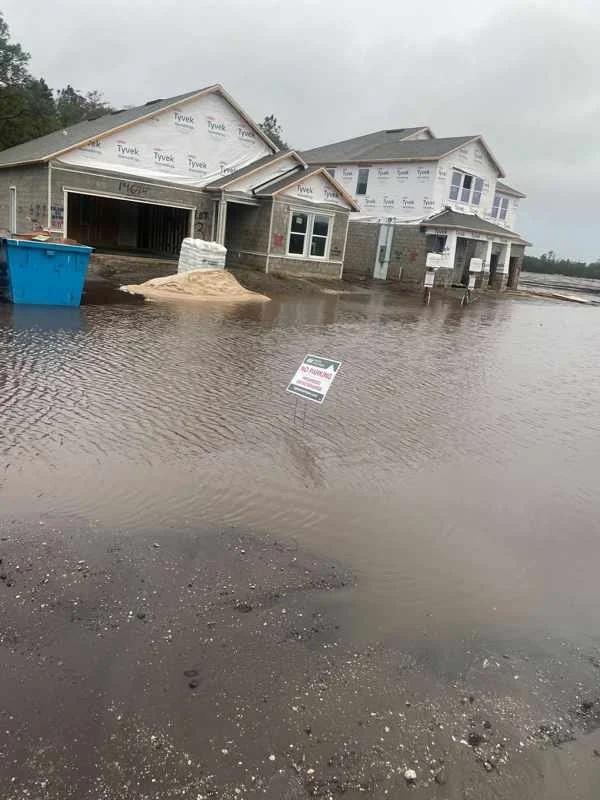
The last time Tallahassee tightened the rules on building, Jeb Bush was governor. Everything since has gone the other way, and the water knows it.
By Joseph J. Jackson | FLORIDA (Nov. 19, 2026)
The short version
Florida led the country on flood and growth rules in the 1980s. The last time the state tightened them was 2005, under Jeb Bush.
In 2011, Rick Scott and the Legislature killed the agency that reviewed new development. The rule for how new building handles its runoff went 42 years before a major update.
In 2025, the state froze local governments from passing tougher building rules. This year, the House let the fix die.
What am I looking at?
Two new houses. Still in their wrap. Lot 3. Nobody lives there yet, and they're already standing in water.
The builder's sign out front says "No Parking." It's half underwater. Nobody needed to be told.
This photo has been shared all over. I can't tell you which street it's on. I can tell you it doesn't matter, because this is what Florida keeps building, and it's what Florida's rules allow. I read the record. Here's how we got here.
Didn't Florida used to be good at this?
It did. That's the part that hurts.
1982: Florida became the first state to require stormwater treatment for all new development.
1985: The Growth Management Act. State planners checked city and county growth plans to make sure new development wouldn't harm water supplies and that roads and schools were in place first. Only Oregon had anything like it.
2005: Jeb Bush signed "pay-as-you-grow." The law was built so roads, schools and water would be ready before the growth arrived.
Mid-2000s: Bush's environmental agency started writing one statewide stormwater rule to replace a patchwork of five different water-district standards.
Say what you want about Jeb Bush. On this, he moved the state forward. That was the last time.
Then what happened?
2010: Bills ordering that statewide stormwater rule died in committee in both chambers. The draft standards written that March were never adopted.
2011: Gov. Rick Scott made killing growth management a priority. The Legislature repealed the 1985 law and abolished the Department of Community Affairs, the agency that reviewed new development. Its former secretary, Tom Pelham, said most of the bill was written by lobbyists for business and development groups, including the Florida Home Builders. Local governments were left to police themselves.
2020 to 2024: Lawmakers finally ordered the stormwater update in 2020. They refused to ratify it in 2023. DeSantis signed it in June 2024. The 1982 rule had stood for 42 years. Even then, the key treatment standards were pushed back to late 2025.
2025: SB 180. Pitched as hurricane recovery, it barred cities and counties from passing "more restrictive or burdensome" building and land rules, applied it retroactively and froze local planning until October 2027. More than two dozen local governments sued. Deltona tried a building pause to catch up on drainage anyway.
2026: The bill to fix SB 180 passed the Senate without a single no vote. The House sent it to a committee that never met again. The freeze stands. The courts are now the only thing standing between your city and the builders' lobby.
And every June, the governor's veto pen takes out the drainage money. (Full list: Florida Keeps Flooding. DeSantis Keeps Vetoing.)
Who benefits?
The record answers this one.
The rollback was sold as jobs. The 2011 law, by its own former regulator's account, was largely written by the industry it regulated. The 2025 freeze is listed by the Florida Home Builders Association as a win it protected in 2026.
I'm not saying any builder broke a law. I'm saying the law was rewritten so they wouldn't have to worry about it. Builders build what the rules allow. Since 2011, the rules have allowed more, in more places, with less review.
Why does this keep happening on the east coast?
Because the same choices land hardest where the ground is lowest and the building is fastest. Broward flooded in 2023. It flooded in 2024. It flooded this week. New neighborhoods keep going up on land that holds water, under rules written for 1982 rain.
You can't vote the rain away. You can vote for who writes the rules.
What critics say
Builders and the state say looser rules speed up rebuilding after hurricanes and keep housing costs down, and that tough state review slowed construction for years. Housing costs are real. But a house that floods before anyone moves in isn't affordable. Somebody pays: the buyer, the insurer, the city and, sooner or later, you.
Florida had the rules. Florida had the agency. Florida chose to take them apart.
The sign says "No Parking." The water parked anyway.
Sources
Construction Equipment Guide, Legislature passes Bush's growth bill (2005)
Florida Water Resources Journal, 2010 recommendations never adopted
Planetizen / St. Petersburg Times, growth management repeal (2011)
Florida Engineering Society, stormwater rule not ratified in 2023
Photo: photographer unknown. The photo has circulated widely online; FMNN could not confirm where or when it was taken. If this is your photo, contact FMNN for credit or removal.