
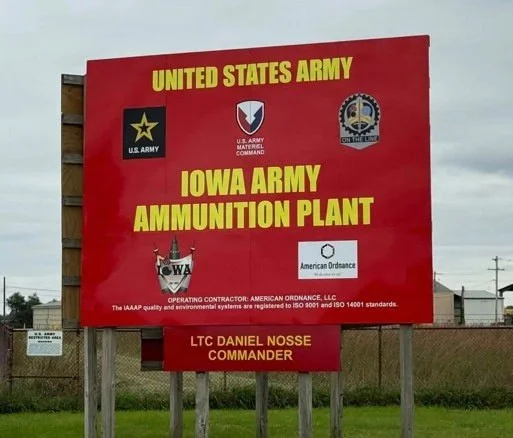
The Army hired a company to chemically neutralize the explosive, then canceled the deal. It owns sealed blast chambers. And it kept the material safe in liquid for two decades before letting it dry out.
By Joseph J. Jackson | ST. PETERSBURG (Nov. 23, 2026)
Update, Nov. 23, 2026, evening: Late Monday afternoon, the Eighth Circuit lifted its pause on the EPA permit, ruling that a controlled detonation with safety measures better limits the risk of harm than the risk of an uncontrolled explosion, NBC News reported. Trump's order still holds the blast until Gov.-elect Rob Sand agrees. The Army had not announced a new date by Monday night. Sources: CBS2 Iowa, CNN.
The short version
The Army wants to blow up about 9,774 pounds of degraded lead azide in the open at the Iowa Army Ammunition Plant in Middletown. On Monday, President Trump ordered it to wait for a federal appeals court and Iowa's governor-elect to sign off.
In March, the Army hired a company to chemically neutralize the material without an explosion, then canceled the contract about two months later. The Army's own assessment says chemical treatment would have avoided the lead dust plume.
The military has destroyed dangerous munitions in sealed steel chambers for more than 20 years. In 2015, residents of a Louisiana town pushed the government away from open burning and toward a sealed system, and it worked.
People keep asking the same thing: why can't they just bury it, move it or put it in something?
The Army's answer is that it's too late. The lead azide has turned into crystals that are sensitive to shock and friction. The Army says moving the drums, or even taking the lids off, could set them off. That rules out burial, which means digging and moving. The Army says it also rules out every other option.
But the record shows the military had safer tools, and in some cases it had already started using them. It just didn't finish.
Option 1: Neutralize it with chemicals. The Army hired someone to do it.
Lead azide can be destroyed with chemicals instead of an explosion. In March, shortly after finding the crystals, the Army awarded a contract to MuniRem Environmental, a Georgia company that neutralizes munitions with chemicals, The New York Times reported Saturday. The Army canceled the deal about two months later.
The Army's own assessment admits chemical treatment had an environmental advantage: no lead dust plume. The Army decided the risk to workers of opening and handling the drums outweighed that.
MuniRem's chief executive, Valentine Nzengung, told the Times that then-Army Secretary Dan Driscoll made the final call to blow it up. The Times also reviewed an email from an Army contracting officer saying the cancellation had nothing to do with problems in MuniRem's technical plan.
Court filings say the Army canceled over safety concerns, CNN reported. Either way, the Army had a contractor and a plan, and the plan wasn't rejected for technical problems. Then it switched to a blast.
Option 2: Blow it up inside a sealed steel chamber.
The military doesn't have to set off explosives in the open. It has built machines for exactly this.
The Explosive Destruction System. It was developed by Sandia National Laboratories for the Army. It's a sealed stainless-steel vessel on a trailer that contains the blast, vapor and fragments, which the Army calls an alternative to open detonation. It has been trucked to sites from Arkansas to Hawaii to destroy old chemical weapons that were too dangerous to ship.
Static detonation chambers. The Army uses them at Anniston, Alabama, and Blue Grass, Kentucky, to destroy mustard-agent shells. The exhaust goes through a pollution-control system instead of drifting over farmland.
The honest catch: these chambers are built for single munitions, not tons. The Army's sealed trailer is rated for about 1.5 pounds of TNT equivalent per shot. Iowa has 68 drums averaging more than 140 pounds each. A chamber would mean opening the drums and feeding in small amounts, which is the handling step the Army says it can't do safely anymore. That's why the timeline matters (see below).
Option 3: Do what Louisiana did.
In 2014 and 2015, about 15 million pounds of unstable M6 propellant sat at Camp Minden, Louisiana. The first plan was to burn it in the open. Residents fought back. The EPA and the Louisiana Military Department reviewed alternatives and picked a contained burn system: a sealed steel chamber with a pollution-control system. In 2016, the EPA said testing showed it destroyed 99.99% of the chemicals of concern.
M6 propellant is a different material, and it burns rather than detonates. The lesson is the process: when the public pushed, the government found a contained option and took the time to do it right.
The Army has done this before with lead azide.
A 1984 paper by the safety officer at Savanna Army Depot in Illinois, just up the Mississippi from Middletown, describes the Army destroying bulk lead azide stored in deteriorating 55-gallon drums. It used electrolysis instead of an open blast. The paper lists half a dozen chemical methods for destroying lead azide.
It wasn't perfect. Workers were overexposed to azides, a small explosion happened, and the project stopped after about half the stockpile was destroyed. But it shows the Army knew decades ago that deteriorating drums of lead azide don't have to be blown up in a field.
So why is a blast "the only option" now?
The material sat at the Iowa plant for more than 20 years. It was stored in a water-and-ethanol mix, which keeps lead azide stable. By March, the liquid had evaporated and needle-shaped crystals had formed.
Even the groups suing the Army now say a blast may be the only option left, because the problem was allowed to drag on so long. The Army hasn't publicly explained why the lead azide wasn't destroyed before it got this dangerous.
That's the real story. The safer methods weren't missing. They were skipped or put off until the Army could say it was too late for them.
Where it stands
The blast is on hold. On Monday, President Trump said on Truth Social that he had ordered the military to wait "until such time as the Eighth Circuit agrees that we can go forward." He also made it subject to the agreement of Iowa's Democratic governor-elect, Rob Sand. Trump still says disposing of the material is the right call, and he warned he would hold Sand responsible for "any and all death or destruction" if Sand refuses. As of Monday afternoon, Sand had not responded publicly.
That reverses the Army's plan. Over the weekend, the Justice Department told the court the Army could go ahead without a permit under an emergency exemption for explosives, and the Army had set the blast for Wednesday, Nov. 25.
An appeals court paused the EPA's emergency permit on Nov. 19 and hasn't ruled on whether to block the blast for good.
The Army's plan, if it goes ahead, includes two-story sand barriers and water spray to hold down the dust.
The pause buys time. The open question is whether the Army uses it to take another look at the options it set aside, or just waits for permission to set off the same blast.
Questions the Army still hasn't answered
Why was the MuniRem neutralization contract canceled if, as the Times reported, it wasn't for technical reasons?
Who decided to let the water-and-ethanol mix dry out, and when did the Army last inspect the drums before March?
Did the Army look at re-wetting the drums remotely, or using robots to feed small amounts into a sealed chamber?
Will the Army release its full alternatives analysis before any blast?
Now that the blast is paused, will the Army ask MuniRem or anyone else to look again?
FMNN will post updates as replies on this story.
Sources
Iowa Public Radio, Army canceled the chemical treatment contract (Nov. 21, 2026)
Al Jazeera, Army environmental assessment alternatives and storage history (Nov. 23, 2026)
Iowa Public Radio, Wednesday date and emergency exemption (Nov. 22, 2026)
Iowa Capital Dispatch, EPA letter that the Army "considered and exhausted" alternatives
U.S. Army, Explosive Destruction System as alternative to open detonation
EPA, Camp Minden contained burn approval, 99.99% (June 13, 2016)
Reuters via U.S. News, Trump orders the Army to pause (Nov. 23, 2026)
Photo: Iowa Army Ammunition Plant sign. U.S. Army photo by Lori McFate, via DVIDS, public domain.