
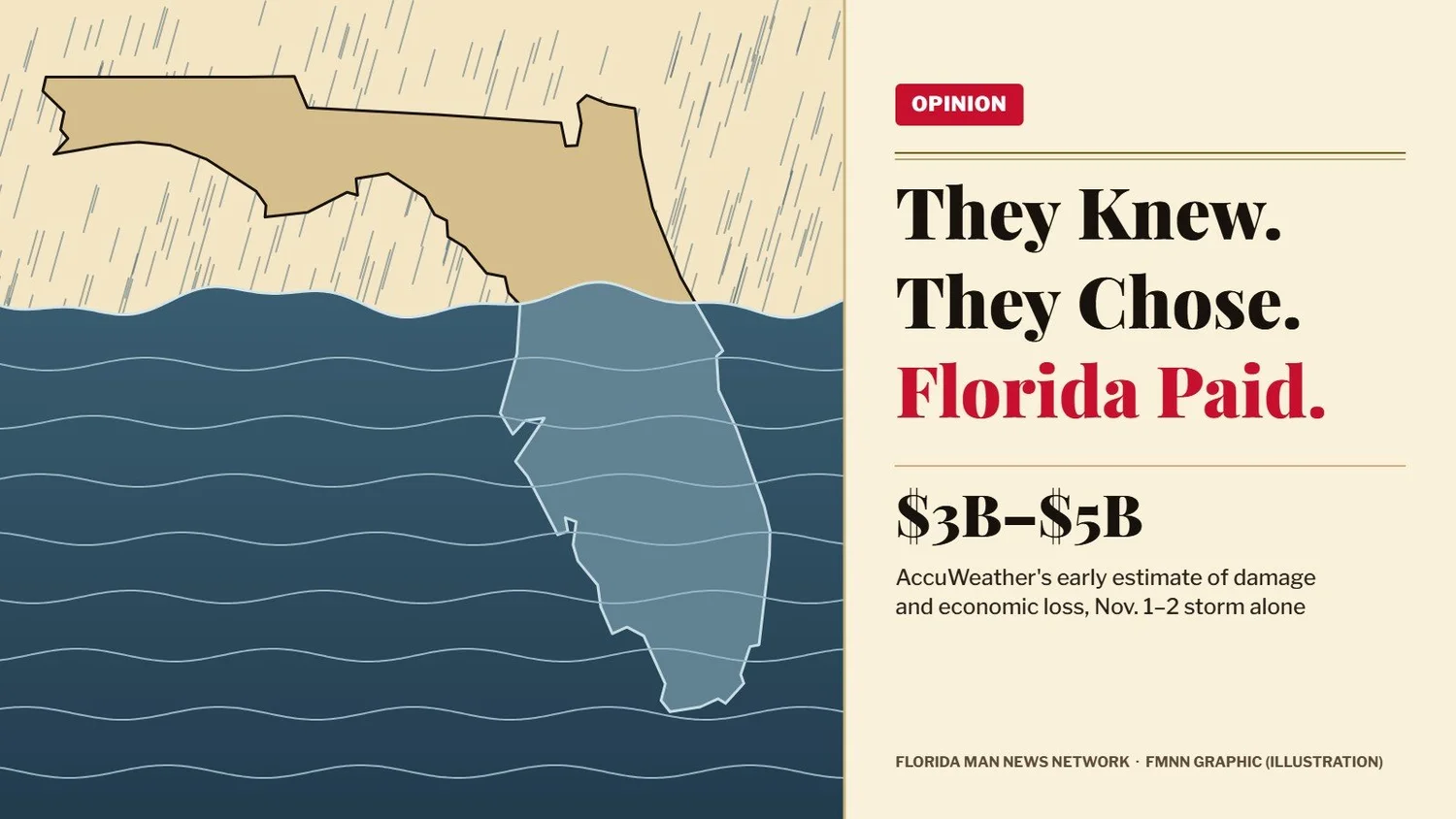
Tallahassee was told what happens if Florida does nothing. It did nothing, and Florida flooded. That was the plan, and the people living where the water goes got the bill.
By Joseph J. Jackson | TALLAHASSEE (Nov. 20, 2026)
The short version
Three floods in three weeks. AccuWeather's early estimate for the first one alone is $3 billion to $5 billion in damage and economic loss.
Every June, the governor's veto pen took out drainage money. The Legislature kept the state's flood program near its legal minimum, zeroed out Florida Forever and froze cities from writing tougher building rules.
They were warned, and they did nothing. When you're told what doing nothing will cost and you do it anyway, doing nothing is the plan. That's a dereliction of duty, and I think it should be prosecuted as criminal negligence.
What did November cost us?
Start with the water.
Nov. 1–2: More than 28 inches of rain fell on Palm Bay. Forecasters called it a 1-in-1,000-year rain. Riviera Beach got more than 19 inches in 12 hours, according to the governor's own executive order. Roads washed out, water service was shut off and polling places had to move on Election Day. Two people died.
Nov. 17–19: Parts of Broward got more than 15 inches. People were rescued from cars, a temple roof collapsed in Hollywood and schools closed.
Right now: The St. Johns River broke its 1953 record near Cocoa. It drops about an inch a mile, so forecasters say Cocoa could still be flooding in January 2027.
The state's flood emergency now covers 21 counties. AccuWeather's early estimate for the Nov. 1–2 storm alone is $3 billion to $5 billion in damage and economic loss. That number came before Broward went under and before the St. Johns broke its record.
Some of that loss sits in homes with no flood insurance, in small businesses and in paychecks people never collected. One Broward business owner with no flood coverage told CBS Miami his business took about $200,000 in damage.
Didn't they know?
They knew. The record says so, year after year.
Fort Lauderdale got 25.91 inches in April 2023 and more than $1 billion in damage.
South Florida flooded again in June 2024.
Florida's own resilience plan ranks hundreds of local flood projects every year. The state knows which drains are too small because cities tell it, in writing, when they ask for money.
The Florida Council of 100, a business group and hardly a left-wing outfit, told the state to fund flood resilience at $500 million a year.
They were told what happens if you do nothing. They did nothing, and it happened.
When you're warned and you choose that outcome anyway, it isn't an accident or bad luck. It's the plan. And the plan was to let it flood and let the bill land on the people who live where the water goes.
What did they choose instead?
The governor chose the veto.
2023: $3.14 million in South Florida flood and drainage work.
2024: About two dozen stormwater and drainage projects, cut while South Florida was flooding.
2025: More than 60 stormwater, wastewater and flood projects statewide.
2026: More than $23 million in South Florida water and flood projects, plus $10 million from the state's flood-grant program itself.
The Legislature chose the minimum.
Resilient Florida: State law requires only $100 million a year. Lawmakers gave the program about $170 million in 2025 and $160 million this year after the veto. That is a third of what the Council of 100 asked for. About six of every seven communities that apply get nothing.
Florida Forever: This is the state's land program, and it protects drinking water and the wetlands that soak up flood water. In 2023 lawmakers wrote into law that it would get $100 million a year. In 2025 they gave it $18 million, down from $229 million the year before. This year they gave it nothing and moved the money to farm easements. Even the governor had asked for $115 million. A poll found 78% of Republican voters wanted the $100 million.
Both chose the builders.
2025, SB 180: It was sold as hurricane recovery. In practice it barred cities and counties from passing "more restrictive or burdensome" building rules and froze local planning into October 2027. It was sponsored by Sen. Nick DiCeglie and carried in the House by Rep. Fiona McFarland. It passed 34-1 and 106-0, and to be fair, Democrats voted for it too. More than two dozen local governments sued.
2026: The bill to fix SB 180 passed the Senate without a single no vote. Then the House sent it to a committee that never met again. Republican House leadership let it die.
And the money went somewhere. The state's emergency agency, the one that answers floods, spent $370 million on Alligator Alcatraz in three months. Its own projection put the cost at about $1.065 billion.
Could they have stopped the vetoes?
Yes, and they proved it.
In January 2025, Republican lawmakers overrode a DeSantis veto for the first time in his years as governor. The House voted unanimously and the Senate voted 35-1. What did they restore? Fifty-seven million dollars for the Legislature's own back-office operations.
The House later voted to restore a few local water items. The Senate president said there were no plans for more overrides. Every drainage veto I listed above still stands.
So when it was their own budget, they found two-thirds in a day. When it was Lauderhill's drains, they found the exits.
Who's responsible?
Republicans have held the governor's office since 1999 and both chambers of the Legislature since the 1990s. Until this month they held two-thirds supermajorities. Every budget in this story was written by Republican leaders, passed by Republican majorities and signed by a Republican governor:
Gov. Ron DeSantis, who held the veto pen.
Senate President Ben Albritton and House Speaker Daniel Perez, who wrote the last two budgets.
Senate President Jim Boyd and House Speaker Sam Garrison, who take over now. Boyd has already said he won't commit to the incoming governor's insurance plan.
Gov.-elect Byron Donalds, whose platform includes no flood plan at all.
This isn't one bad budget or one bad governor. It's a party that has run this state for nearly 30 years, was told what was coming, and made the same choice every year. When you hold all the power, you own all the results, and that goes for every one of them who went along.
Their side
The governor's office says the vetoes trim "nice to have" projects. It says Resilient Florida is the largest flood program in state history, with $1.8 billion awarded since 2021, and that smaller budgets keep taxes low and pay down debt. Supporters of SB 180 say it speeds up rebuilding after hurricanes. And some of this rain, 19 inches in 12 hours, would overwhelm any drain ever built.
None of that answers the question. Drains limit floods; they don't end them, and that's exactly why you build them before the storm. A billion dollars for a detention camp and a red pen for drains is a choice.
In the end
In the end, they chose to let people suffer. They chose to let families risk their lives in flooded cars and flooded homes, and people died. They chose to let the losses pile up, and those losses get priced into everyone's insurance bill and make Florida harder to live in, one renewal at a time.
They were told. They did nothing. It flooded. That's a dereliction of fucking duty.
I believe it's criminal negligence, and it should be investigated and prosecuted as criminal negligence. If Florida law says a governor and a Legislature can't be charged for doing nothing while they were warned, then that law needs to change too.
They knew. They chose. Florida paid. And I'm keeping the receipts.
Read next
Sources
AccuWeather, $3B–$5B preliminary estimate; 28+ inches in Palm Bay (Nov. 4–5, 2026)
Florida Executive Order 26-228, Riviera Beach 19+ inches in 12 hours (Nov. 4, 2026)
CBS Miami, South Florida flooding live updates (Nov. 19–20, 2026)
E&E News, Resilient Florida and the Council of 100 (May 27, 2026)
Florida Politics, Resilient Florida near the statutory minimum
Central Florida Public Media, budget lacks Florida Forever funding (May 28, 2026)
Graphic: FMNN illustration. Florida's outline is to scale; the water line is not a forecast or a measurement.