
EXPLAINERS | ENCRYPTION, PART 2 OF 3
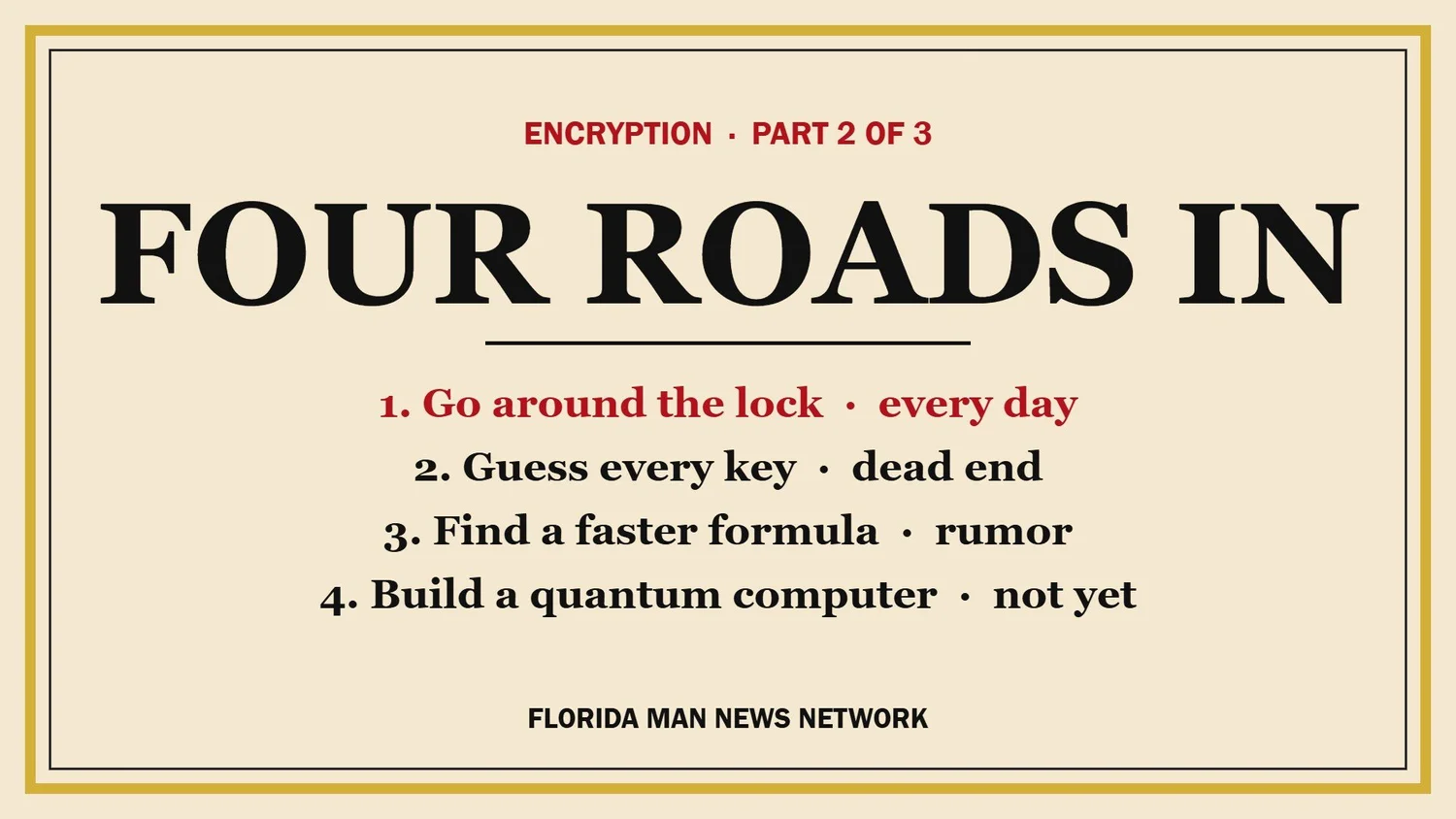
There are four roads in. Three are slow or imaginary. One is wide open, and it has nothing to do with math.
By Joseph J. Jackson | ST. PETERSBURG, Fla. (Nov. 26, 2026)
The short version
Almost nobody beats the math. Attackers go around it: a software flaw, a stolen key, a tricked employee, or a connection that was never locked.
Guessing every key is hopeless. A faster formula is what this week’s AI rumor claims, and nobody has shown one. A quantum computer big enough doesn’t exist yet.
The estimates for that quantum machine keep dropping, and AI is helping build it.
This month, attackers went after more than 1,600 Bitcoin mining sites and skimmed the miners’ earnings. They didn’t crack a single code. The connection those miners used was never encrypted in the first place, Coinpedia reported, citing the mining company Braiins.
That’s the first thing to know about breaking encryption. The math is the last place a thief looks.
Yesterday I showed you the lock. Today, the four roads in.
Road 1: Can you go around the lock?
Yes, and this is how nearly every real break-in happens.
Verizon studies thousands of breaches a year. Its 2026 report found 31% started with a flaw in software, the company said. That passed stolen passwords for the first time in the report’s 19 years. A human mistake showed up in 62% of breaches, by Mimecast’s read of the same report.
Going around looks like this:
Steal the key. The lock is perfect and the thief has your key. Game over.
Trick the person. A fake text gets you to hand over the password yourself.
Find old software. The lock is fine, but the door it’s bolted to has a hole.
Find the door with no lock. Like those miners.
What it takes: patience and a phone. Status: happening every day.
Road 2: Can you guess every key?
No. A standard one-key lock has more possible keys than a 77-digit number can count. Every computer on Earth, running until the sun burns out, doesn’t make a dent.
This is why “they’ll just use a faster computer” is the wrong worry. Faster guessing doesn’t beat that number.
What it takes: more time than the universe has. Status: dead end.
Road 3: Can you find a faster formula?
This is the road the rumor is about.
Remember the napkin: multiplying is easy, going backward is the hunt. The two-key lock called RSA is safe only as long as nobody finds a shortcut for the hunt.
People have been getting better at the hunt the slow way. The public record sat at an 829-bit number from February 2020 for six and a half years. Then it fell twice in 16 days this September, both times with AI coding tools doing the engineering, Byteiota reported. The second one, an 896-bit number, was done by an Anthropic engineer using the company’s Claude model on up to 2,048 graphics chips, PostQuantum.com reported.
Neither used new math. They used the old method on more chips. Real keys are 2,048 bits, and at that pace one would take about a trillion GPU-years, by PostQuantum.com’s estimate.
Now the rumor. Scott Aaronson, a University of Texas computer scientist, wrote Tuesday night that he has heard “many, many rumors” that OpenAI, Anthropic or both have a true shortcut. He said he doesn’t know how much to credit them. He later said he is virtually certain the labs have some cryptography bombshell and far less sure what it is.
Here’s the record as of Wednesday night. No paper. No proof. Neither company had commented by Wednesday evening, SteamDB’s news desk reported. A viral post claimed this is why the labs are holding back their newest models. The Axios report behind that claim describes staff worried about controlling the models, not about codebreaking, per The Rundown’s summary.
One more caution. A shortcut for RSA would not open the other two-key lock, the curve-based one in your phone and in Bitcoin. That’s separate math, and its rumor is just as unproven.
What it takes: a discovery no one has shown. Status: rumor.
Road 4: Can you build a different kind of computer?
In 1994, mathematician Peter Shor proved a big enough quantum computer could do the hunt fast. It would break both kinds of two-key lock.
“Big enough” keeps shrinking. In 2012 the estimate for a 2,048-bit key was a billion qubits, the building blocks of these machines. Last year Google put it at about a million. In October, French company Alice & Bob estimated 22,593 qubits and about three days.
Those are paper estimates. Google’s best chip has 105 qubits, per Physics World.
The one-key lock mostly survives this road. A quantum computer weakens it but doesn’t break it.
What it takes: a machine nobody has built. Status: coming, date unknown.
Analysis: Where does AI fit?
On three of the four roads.
On Road 1, it writes better scam messages and finds software flaws faster. Verizon said AI is cutting attack time from months to hours.
On Road 4, it’s helping build the quantum computer. Google uses a neural network to catch the errors that keep those machines from working, per its paper.
Road 3 is the one that should change how we think. The old assumption was that the two-key locks were safe until somebody built a giant quantum machine, and we’d see that coming for years. AI that does new math removes the warning. The lock could fail on an ordinary Tuesday, out of a data center.
It hasn’t. But “we’d see it coming” isn’t something anyone can promise now.
This afternoon: who has to fix the lock, why Bitcoin has the hardest job, and what to ask your bank.
Next, Part 3: Who Fixes the Lock Before It Breaks?
Disclosure: FMNN uses Claude, an AI model made by Anthropic, to help research and draft stories. Anthropic is one of the companies in this story. Every story is edited and approved by Joseph J. Jackson.