
EXPLAINERS | ENCRYPTION, PART 3 OF 3
Washington has set a deadline. Banks can meet it over a weekend. Bitcoin can’t, and nobody is in charge of making it.
By Joseph J. Jackson | ST. PETERSBURG, Fla. (Nov. 26, 2026)
The short version
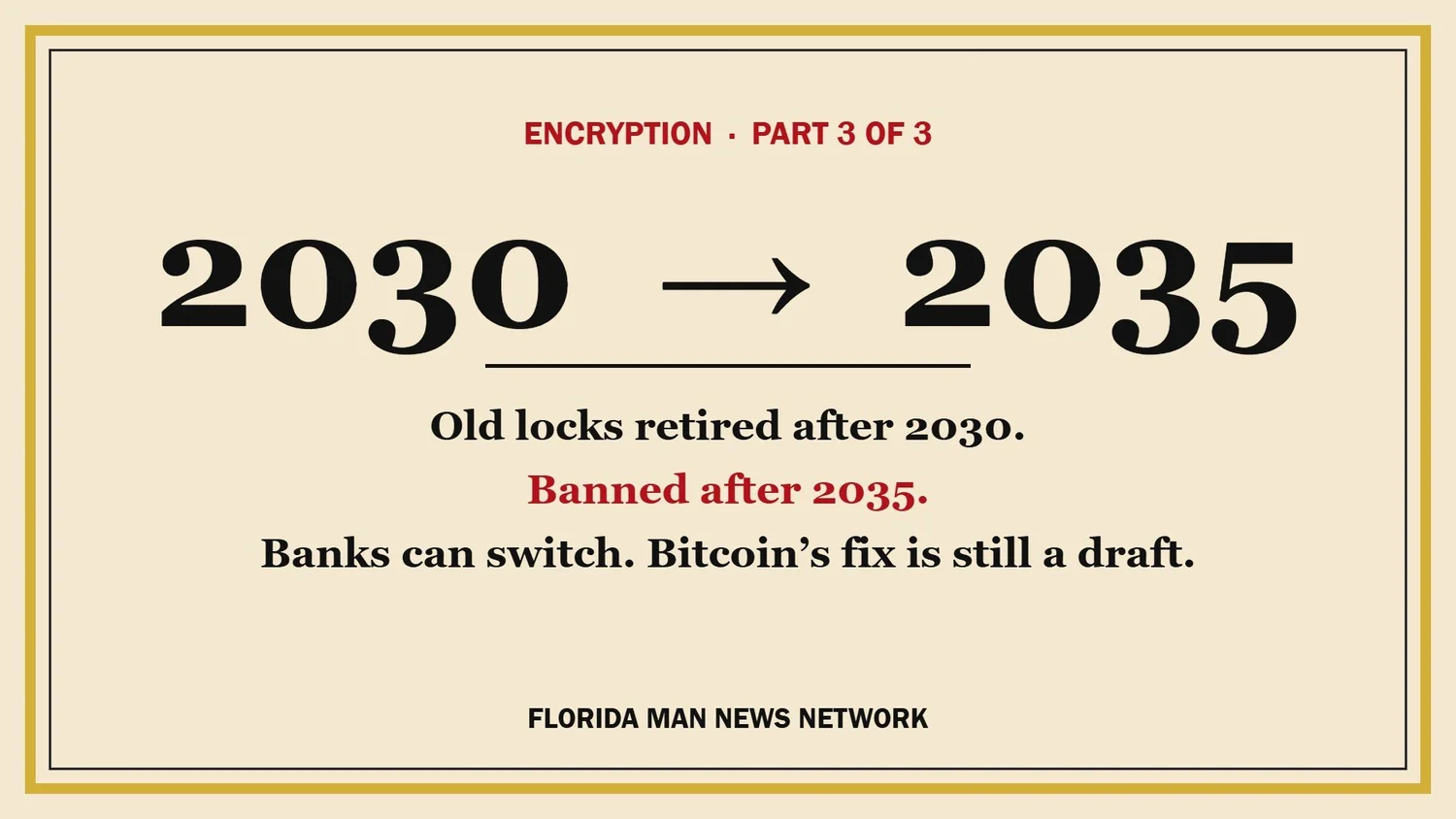
New locks built on different math already exist. Federal standards retire the old two-key locks after 2030 and ban them after 2035.
Bitcoin has the hardest version of the job: its keys are already public, nobody can push an update, and its fix is still a draft.
The work belongs to banks, hospitals, utilities and governments. Your job is to keep devices updated and ask them when they’re switching.
On Oct. 27, the federal government’s standards agency put dates on the death of the locks you’ve been reading about for two days. Almost nobody outside the security business noticed.
Part 1 showed you the lock. Part 2 showed you the four roads in. This is who has to fix it, and who’s furthest behind.
Is there a new lock?
Yes. The National Institute of Standards and Technology released new two-key locks in August 2024, built on math that quantum computers aren’t known to beat.
The schedule, finalized Oct. 27: the old two-key locks are deprecated after 2030 and disallowed after 2035, Help Net Security reported. A June executive order told every federal agency to rank its critical systems and write a plan to move them, according to the White House budget office memo.
Why the hurry if the quantum computer isn’t built?
Three words: harvest now, decrypt later.
An adversary doesn’t need to read your data today. It can copy the scrambled version, store it, and wait. Federal agencies say that may already be happening. Anything that still matters in ten years is exposed now: medical records, Social Security numbers, state secrets.
And the switch is slow. Only 38% of organizations are actively working on it, according to the security firm Entrust.
Is the new lock safe?
As far as anyone has shown, yes.
You should know there’s a rumor here too. It says an AI lab found an attack on a math problem related to the new locks. Like the factoring rumor in Part 2, nobody has produced proof. If it turned out to be true, the replacement would be in trouble before most people installed it.
That’s one reason engineers are being told to build systems that can swap locks quickly. No lock is forever.
Why is Bitcoin’s problem different?
Start with a correction to what’s going around. The rumor about factoring would not open one Bitcoin wallet. Bitcoin doesn’t use RSA. It uses the curve-based lock.
A quantum computer breaks that lock too, and sooner. Blockchain keys are much smaller, so a smaller machine can crack them. In March, Google estimated fewer than 500,000 qubits and a few minutes, The Block reported.
Then come three problems a bank doesn’t have.
The keys are already public. Nobody has to harvest anything. More than 6 million bitcoins, 31.2% of the supply, sat behind publicly exposed keys in October, CoinDesk reported.
Nobody can push the update. A bank can change its locks over a weekend. Bitcoin needs its users to agree on a fix, and then every holder has to move their own coins. Its two repair proposals are still drafts with no start date, TFTC reported.
Lost coins can’t be moved. Moving a coin to a new lock takes its private key. That includes more than 1.1 million bitcoins tied to Bitcoin’s creator, PostQuantum.com noted. If those keys are gone, those coins sit there as a prize.
And there’s no fraud department. A bank can make you whole after a break-in. On a blockchain, whoever holds the key owns the coins, and the transfer doesn’t come back.
Ethereum is further along. Its foundation formed a post-quantum team in January and is aiming for about 2029, a date it calls a plan and not a promise, per its own roadmap.
One thing the record doesn’t show: that this week’s rumor moved prices. Bitcoin traded near $58,400 Wednesday morning, down 28% in a month, Investing.com reported. That slide started weeks earlier.
Analysis: What does “quantum AI” change?
People mean two things by it.
One is AI building the quantum computer. That’s real. In July, Google showed an AI agent holding a quantum computer steady through long runs. Every gain like that pulls the deadline closer.
The other is quantum computers running AI. That’s still a promise. No public result shows quantum hardware beating ordinary chips at training AI.
Put the two together with Part 2 and here’s where I land. The 2035 date assumes the old locks fail when the quantum machine arrives. Ethereum researcher Justin Drake warned in October that AI might crack blockchain signatures before any quantum computer does, BigGo Finance reported. If he’s even partly right, 2035 is the generous version.
Prepare for the worst, hope for the best.
What can I do?
Tonight: keep your phone, computer and browser updated. New locks reach you through updates. Use a password manager and turn on two-step login, because Road 1 is still how people get robbed.
If you hold crypto: don’t reuse wallet addresses, and keep your wallet software current so you can move when a fix arrives. That’s not a call on whether to buy or sell.
The part that matters most: ask. State technology chiefs have been told this is coming. Their national association put out a call to action for state governments, GovTech reported.
Ask your bank: when do you switch to post-quantum encryption?
Ask your hospital system the same question about your records.
Ask your county and Tallahassee: is there a written plan, and what’s it cost?
If the answer is a blank stare, that’s the story, and I want to hear about it.
Two days ago, one comment on one blog shook the internet’s faith in its own locks. Now you know what the lock is, how it breaks and who’s supposed to fix it. That’s more than most of the people who shared the rumor.
Disclosure: FMNN uses Claude, an AI model made by Anthropic, to help research and draft stories. Every story is edited and approved by Joseph J. Jackson.